Rosewater ice with fine starch noodles, lime, and sour cherry
A fragrant rosewater syrup is frozen to a loose crystalline slush and folded around delicate homemade starch noodles. Fresh lime sharpens the sweetness, while sour-cherry syrup and pistachios can be added at the table.
Natural kitchen ambience accompanies this short film. Use the player controls to enable sound.
Across time and place
History & origin
Faloodeh belongs to Iran’s long tradition of chilled and frozen sweets. The style identified with Shiraz—fine starch noodles in rosewater ice, commonly sharpened with lime—is the country’s best-known regional form and remains strongly associated with the city, although faloodeh is enjoyed throughout Iran. Precise claims that it was the world’s first frozen dessert are difficult to verify, so this recipe makes no exact invention-date claim.
Shiraz, Fars
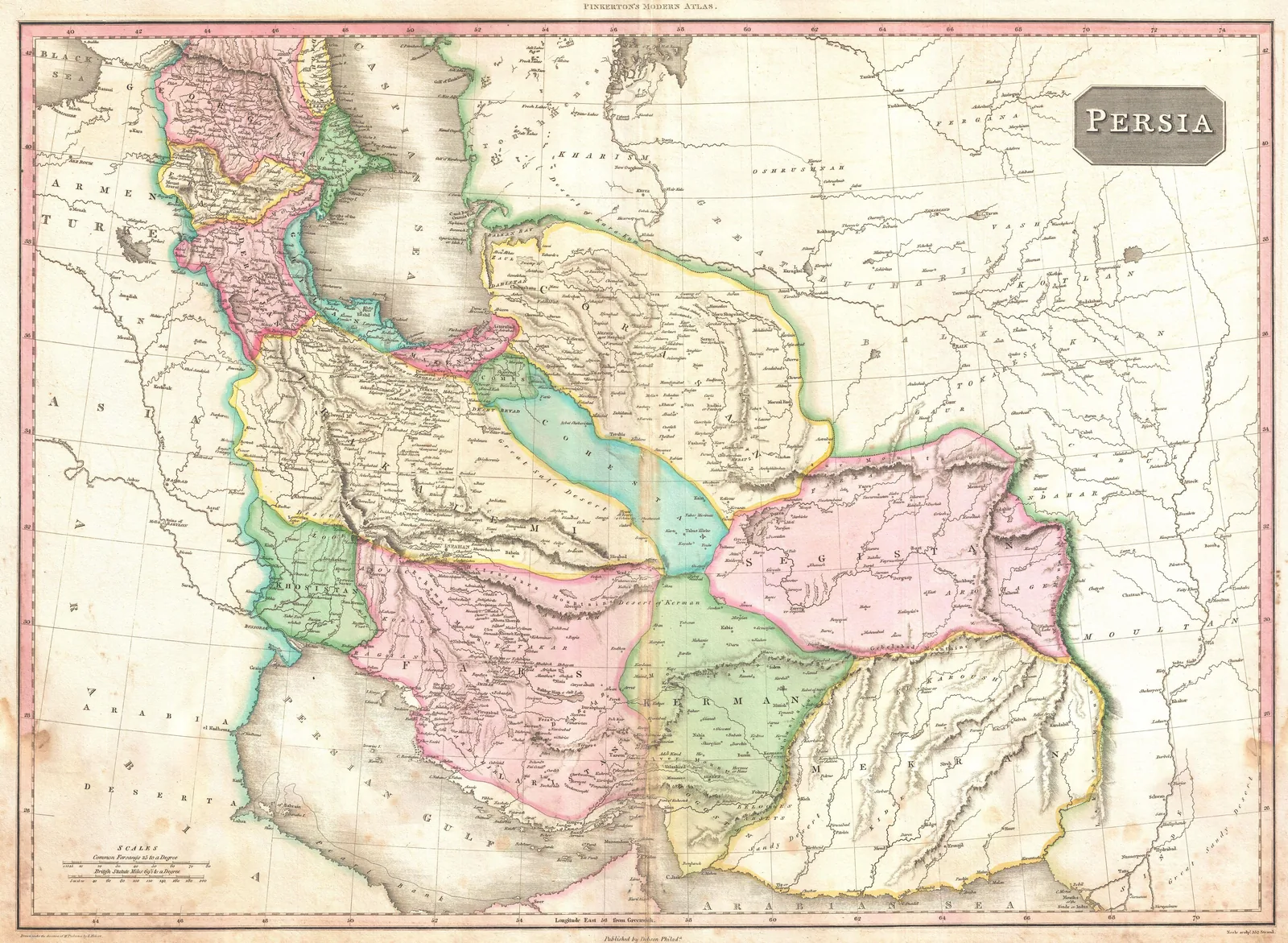
A hand-colored 1818 map by John Pinkerton. Historic borders and spellings reflect the map’s own period; the overlay is an editorial guide to the food story, not a territorial claim.John Pinkerton · Wikimedia Commons · Public domain
⌖The marker identifies Shiraz, the city most closely associated with the familiar noodle-and-rosewater version served today.
01
The historical trail
Iranian ice houses made stored winter ice available for warm-season food and drink long before mechanical refrigeration, and historical discussion of yakhchal culture specifically names faloodeh as a popular use of ice. The noodle-and-rosewater dessert remains one of Iran’s signature frozen sweets.
02
Place and tradition
Faloodeh is Iranian; the fine-noodle style in this recipe is specifically associated with Shiraz in Fars Province. Its fame as Faloodeh Shirazi is clearer than any claim about one inventor or an exact date of creation.
Before you begin
Ingredients
Every ingredient includes U.S. and metric quantities, buying guidance, preparation, and a practical substitution.
A visual guide to the principal ingredients; exact quantities appear below.
01Granulated sugar1 1/2 cups/300 g+
Why it mattersSugar sweetens the rosewater ice and keeps it scoopably crystalline rather than solid.
ChooseUse dry, free-flowing granulated sugar.
PrepareDissolve fully in the syrup water before freezing.
SubstituteReducing more than one-quarter may make the ice unusually hard.
AllergenNo common major allergen.
02Water for the syrup2 cups/480 mL+
Why it mattersWater carries the sugar and floral flavor into a clean frozen base.
ChooseUse fresh-tasting potable water.
PrepareCombine with sugar before heating.
SubstituteNo direct substitution is needed.
AllergenNo allergen.
03Culinary rosewater1/3 cup/80 mL+
Why it mattersRosewater provides faloodeh’s characteristic floral fragrance.
ChooseChoose a clean-tasting culinary product without perfume additives.
PrepareAdd after the syrup cools slightly to preserve its volatile aroma.
SubstituteOrange-blossom water creates a different dessert and should be used more sparingly.
AllergenCheck flavored products for preservatives and cross-contact.
04Fresh lime juice1/4 cup, divided/60 mL+
Why it mattersLime cuts through the sweetness and is a familiar accompaniment to Shirazi faloodeh.
ChooseChoose heavy, thin-skinned limes without mold or dry spots.
PrepareJuice through a strainer; add half to the syrup and reserve half for serving.
SubstituteFresh lemon juice works with a slightly softer acidity.
AllergenNo common major allergen; citrus sensitivity is possible.
05Cornstarch1 cup/120 g+
Why it mattersCornstarch cooks into a translucent gel that forms the fine chewy noodles.
ChooseChoose a fresh, lump-free product; use certified gluten-free starch when necessary.
PrepareWhisk into cold water before heating so no dry pockets remain.
SubstituteWheat starch is traditional in some preparations but introduces wheat/gluten and behaves differently.
AllergenCorn is not a US major allergen, but individual sensitivity and cross-contact are possible.
06Cold water for the starch2 cups/480 mL+
Why it mattersCold water disperses the starch before heat gelatinizes it.
ChooseUse fresh potable water.
PrepareWhisk until completely smooth before placing the pan over heat.
SubstituteDo not begin with hot water, which creates difficult lumps.
AllergenNo allergen.
07Cold water for the noodle bath8 cups/1.9 L+
Why it mattersThe bath cools and sets the extruded starch strands immediately.
ChooseUse potable water because it contacts ready-to-eat noodles.
PrepareCombine with ice in a large clean bowl before pressing the noodles.
SubstituteRefresh with more cold water if the bath becomes lukewarm.
AllergenNo allergen.
08Ice cubes4 cups/600 g+
Why it mattersIce keeps the setting bath cold enough to preserve separate strands.
ChooseUse clean ice made from potable water.
PrepareAdd to the noodle bath immediately before extrusion.
SubstituteReusable cooling packs are not suitable because they cannot contact the noodles.
AllergenNo allergen; handle with clean utensils.
09Sour-cherry syrup1/3 cup, optional/80 mL+
Why it mattersTart cherry syrup adds a vivid sweet-sour contrast at serving.
ChooseChoose a syrup with recognizable cherry flavor rather than artificial perfume.
PrepareChill and drizzle over individual portions rather than the full batch.
SubstitutePomegranate molasses is too concentrated for a direct substitution; dilute and sweeten to taste.
AllergenCheck commercial syrup for color additives, sulfites, or cross-contact.
Why it mattersPistachios add color and crunch but are a garnish, not part of the frozen base.
ChooseChoose fresh kernels without rancid odor.
PrepareChop and add immediately before serving.
SubstituteOmit for a nut-free dessert.
AllergenContains pistachio, a tree nut.
11Lime wedges1 lime, cut into 6 wedges/1 (about 80 g)+
Why it mattersWedges let each guest adjust the final acidity.
ChooseChoose a firm, aromatic lime with intact skin.
PrepareWash the rind before cutting because it touches the dessert.
SubstituteUse lemon wedges for a gentler sourness.
AllergenNo common major allergen; citrus sensitivity is possible.
12Fine sea salt1/8 tsp/0.7 g+
Why it mattersA tiny amount sharpens the rose and lime without making the dessert salty.
ChooseUse fine salt for full dissolution.
PrepareDissolve in the warm syrup.
SubstituteOmit if necessary.
AllergenNo common major allergen.
Step by step
Method
Equipment
Shallow metal freezer pan
Medium heavy-bottomed saucepan
Potato ricer with small holes
Large bowl for ice water
Fork and fine-mesh strainer
01
Make the rosewater syrup
Combine sugar, syrup water, and salt. Heat gently, stirring only until clear. Simmer for 2 minutes, remove from heat, then stir in rosewater and half the lime juice.
Time
8–10 minutes
Look for
The syrup is clear with no crystals on the spoon or pan base.
02
Begin freezing the syrup
Cool the syrup, pour it into a shallow metal pan, cover, and freeze until the edges are firm and the center is slushy.
Time
60–90 minutes
Look for
A fork lifts loose crystals from the edge while the middle remains movable.
03
Prepare the ice bath
Fill a large clean bowl with the cold bath water and ice. Position the potato ricer directly over it.
Time
3 minutes
Look for
The water is very cold and plenty of ice remains unmelted.
04
Cook the starch gel
Whisk cornstarch into its cold water until smooth. Cook over medium heat, stirring continuously and scraping every part of the pan as it thickens.
Time
8–12 minutes
Look for
The paste is glossy and translucent, pulls from the pan, and leaves no chalky white streaks.
05
Press the noodles
Working carefully while the gel is hot, load the ricer in small portions and press thin strands directly into the ice water. Keep hands away from steam and hot gel.
Time
8–10 minutes
Look for
Strands set on contact, remain separate, and feel springy rather than dissolving.
06
Chill and drain the noodles
Let the noodles stand in ice water, swish gently to separate, then drain through a fine strainer. Rinse briefly with fresh cold water and drain thoroughly.
Time
10 minutes
Look for
Noodles are cold, distinct, flexible, and no longer release cloudy starch water.
07
Combine noodles and slush
Scrape the semi-frozen syrup into crystals with a fork. Fold in the drained noodles, distributing them evenly without crushing.
Time
5 minutes
Look for
Fine noodles are suspended throughout loose rosewater crystals rather than sitting in a watery pool.
08
Finish freezing
Return the covered pan to the freezer. Scrape and fold every 30 minutes so the mixture remains crystalline and evenly textured.
Time
60–90 minutes
Look for
The dessert mounds softly on a spoon and separates into icy strands when scraped.
09
Adjust before serving
If very firm, rest at room temperature for 5 to 10 minutes and scrape again. Taste and add reserved lime juice a teaspoon at a time.
Time
5–10 minutes
Look for
The texture is spoonable and the sweetness is bright rather than cloying.
10
Garnish and serve
Spoon into chilled bowls. Offer lime wedges and drizzle with sour-cherry syrup; add pistachios only for guests who can safely eat tree nuts.
Time
5 minutes
Look for
The faloodeh reaches the table frozen but loose, with distinct noodles and garnishes.
◌
Storage
Keep tightly covered in the freezer for up to 5 days for best texture. Scrape after 5 to 10 minutes at room temperature before serving. Do not repeatedly thaw and refreeze.
↺
Reheating
Faloodeh is never reheated. Temper briefly at room temperature, scrape to loosen the crystals, and serve immediately in chilled bowls.
✦
Variations
Serve half faloodeh and half Persian saffron ice cream for a common shop-style combination.
Omit pistachios and use a verified nut-free cherry syrup for a nut-free presentation.
Use only lime and no cherry syrup for a clean rosewater-and-citrus profile.
Food safety
Cook with care and judgment
Use clean potable water and ice, fully cook the starch until translucent, and use a heat-safe ricer without touching the hot gel. Cool promptly, keep frozen, and discard any batch with off odors, visible mold, or evidence of repeated thawing.
Allergens
Contains pistachio only when the optional garnish is used.
Use certified gluten-free cornstarch when required; wheat-starch versions contain wheat/gluten.
The starch gel was probably undercooked or the bath was not cold enough. Cook until glossy and translucent, then press immediately into abundant ice water.
02Why is my faloodeh frozen solid?+
It may contain too little sugar or may not have been scraped during freezing. Let it temper briefly, scrape firmly, and follow the measured syrup ratio next time.
03Can I make it without a potato ricer?+
A sturdy noodle press with small round holes works. Avoid piping hot gel through a thin disposable bag, which can split and cause burns.
04Can I use packaged rice noodles?+
They make a convenient frozen noodle dessert, but their texture is different from the springy starch strands characteristic of faloodeh.
Cooked by you
From your table
Share a photo of your dish and a note about how the recipe went. Every submission is reviewed before public display, and submission does not guarantee publication.