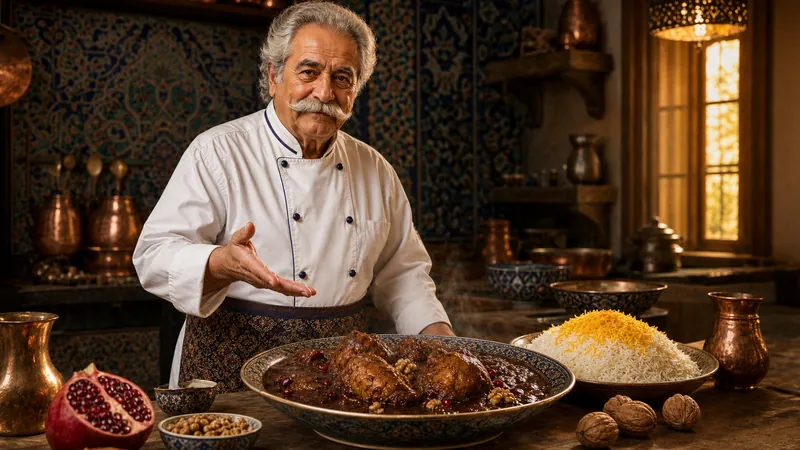
Silky walnut and pomegranate stew with tender chicken
Finely ground walnuts and pomegranate molasses simmer into a dark, glossy sauce around tender chicken. The finished stew is rich but fluid, with a carefully balanced sweet-tart finish.
Natural kitchen ambience accompanies this short film. Use the player controls to enable sound.
Across time and place
History & origin
Fesenjan is a Persian khoresh whose sweet-to-sour balance varies by region and household. Finely ground walnuts, patient low heat, and pomegranate molasses create its characteristic dark, glossy sauce; chicken and duck are familiar versions.
⌖The marker follows the dish’s strongest documented regional association; recipes later spread throughout Iran.
01
The historical trail
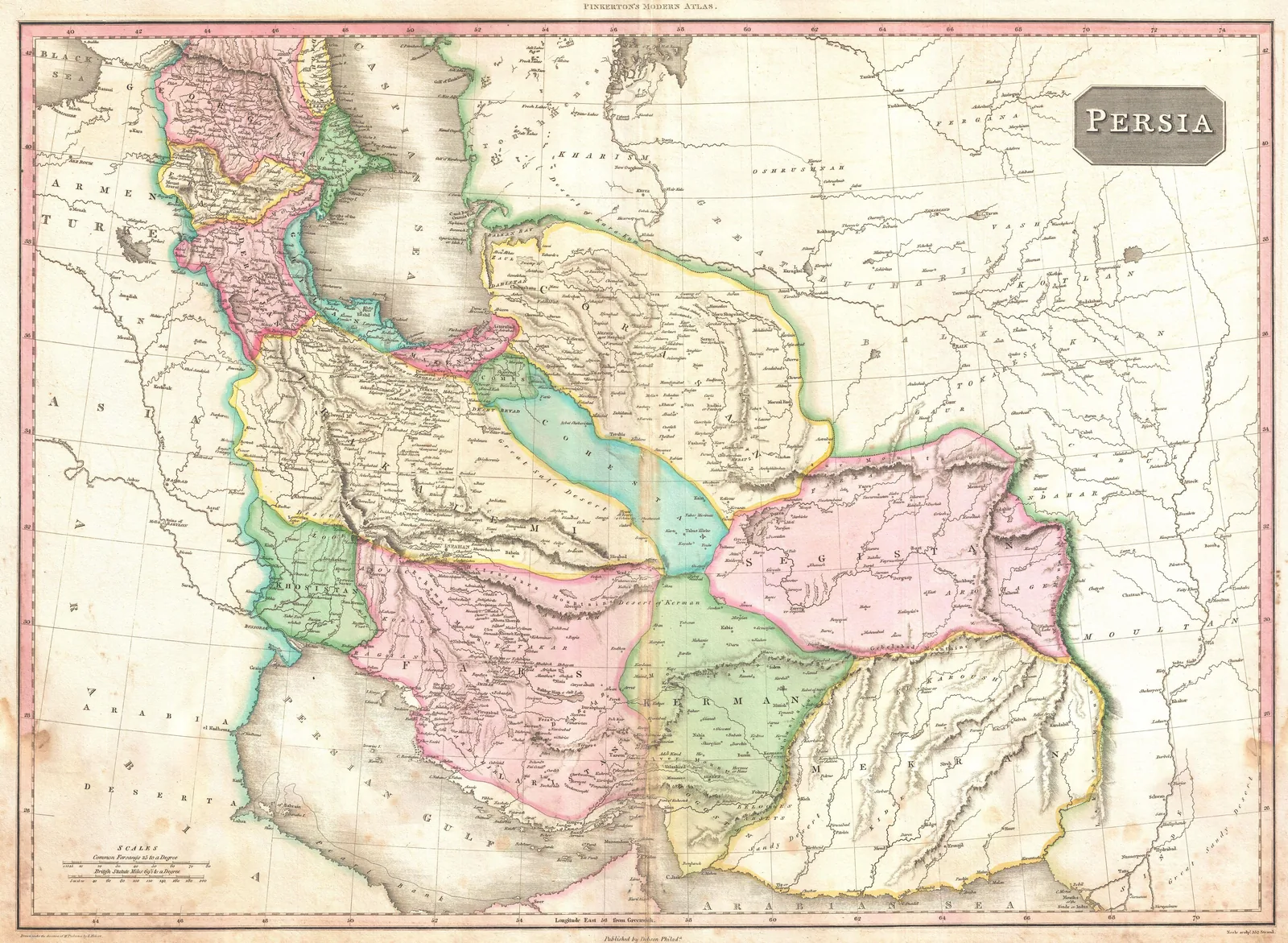
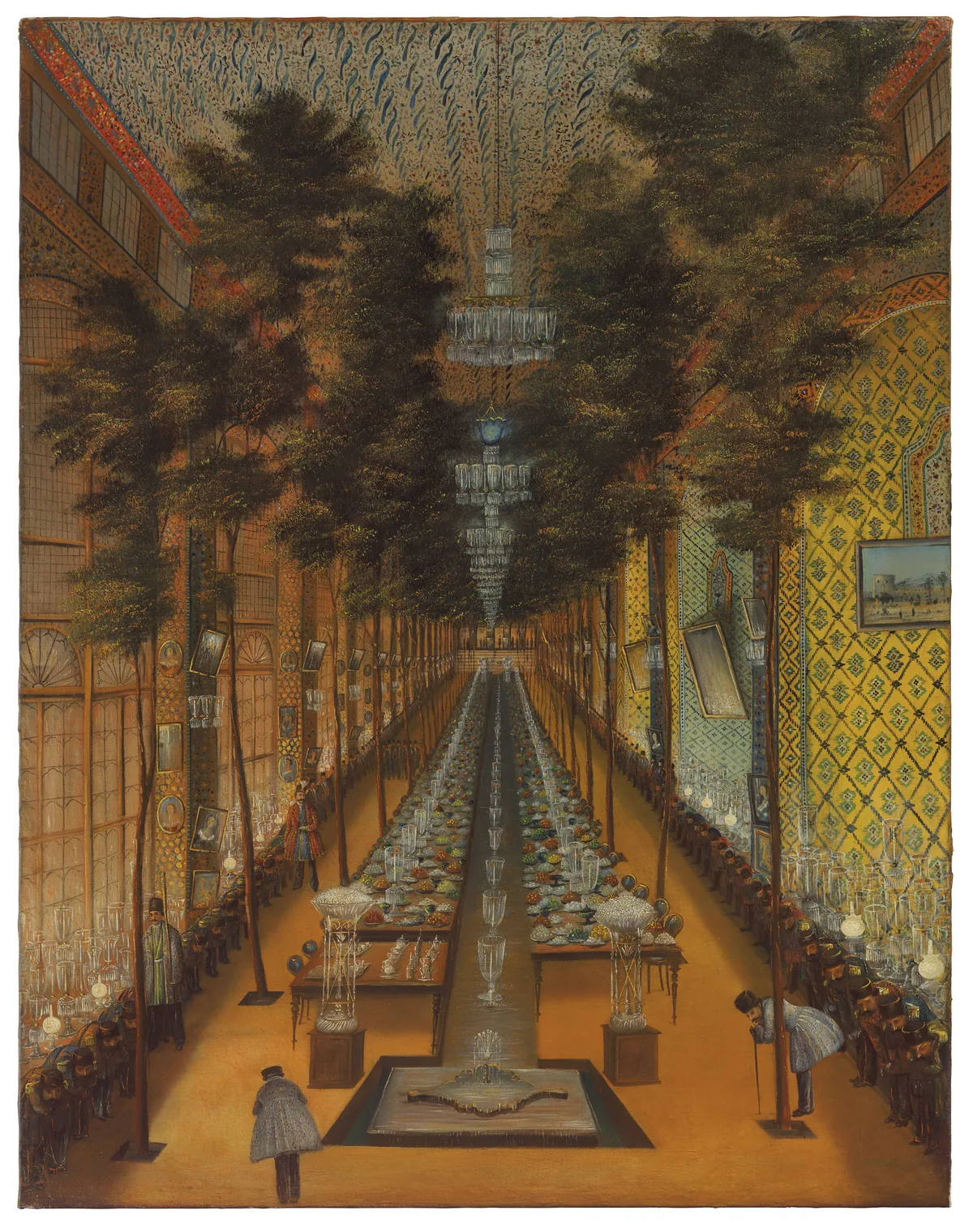
Fesenjan has one of the clearest regional trails among Iran’s celebrated khoreshes. Historical references connect fasujan with Gilan, while later Qajar records document multiple walnut-and-pomegranate versions served with poultry or meatballs.
02
Place and tradition
Encyclopaedia Iranica identifies a strong Gilani association and cites the 1883 Qajar cookbook “Sofra-ye At‘ema,” which records ten varieties. Rashti fesenjan is characteristically sourer and traditionally unsweetened.
Before you begin
Ingredients
Every ingredient includes U.S. and metric quantities, buying guidance, preparation, and a practical substitution.
A visual guide to the principal ingredients; exact quantities appear below.
01Raw unsalted walnuts4 cups/450 g+
Why it mattersWalnuts form the sauce, supplying its body, texture, and natural oil.
ChooseChoose pale, fresh nuts with a sweet nutty aroma, never a paint-like smell.
PrepareWarm gently, cool completely, and grind to a fine damp meal without making nut butter.
SubstitutePecans create a different but workable stew; there is no faithful nut-free substitute.
AllergenContains walnut, a tree nut; unsuitable for anyone with a walnut or tree-nut allergy.
02Bone-in chicken thighs, skin removed6 thighs, about 3 lb/1.35 kg (6)+
Why it mattersDark meat remains succulent through the long simmer and seasons the walnut sauce.
ChooseChoose thighs of similar size so they finish cooking together.
PrepareRemove loose fat, pat dry, and keep refrigerated until browning.
SubstituteSkinless drumsticks or boneless thighs work; boneless pieces need less time.
AllergenNo common major allergen; check pre-brined poultry for added ingredients.
03Yellow onions2 medium, finely diced/300 g+
Why it mattersSlow-browned onion rounds out the tart sauce with savory sweetness.
ChooseUse firm onions with dry skins and no green shoots.
PrepareDice finely so the onion melts into the sauce.
SubstituteThree large shallots may replace the onions.
AllergenNo common major allergen; allium sensitivity is possible.
04Pomegranate molasses, preferably unsweetened1/2 to 3/4 cup/120–180 mL+
Why it mattersPomegranate molasses gives fesenjan its fruitiness, color, and sweet-tart structure.
ChooseTaste before using; brands range from sharply sour to sweet and concentrated.
PrepareBegin with the smaller amount and add more only after the sauce has simmered.
SubstituteReduce 2 cups (480 mL) pure pomegranate juice to about 1/2 cup (120 mL) for a lighter result.
AllergenPure molasses has no common major allergen; read labels for additives and shared equipment.
05Cold water5 cups, divided/1.2 L+
Why it mattersWater extracts the walnut flavor gradually and becomes the silky sauce.
ChooseUse clean-tasting filtered water if tap water is strongly chlorinated.
PrepareStart with 4 cups; add the final cup in small cold portions during cooking.
SubstituteUnsalted chicken stock may replace up to half, but produces a heavier background flavor.
AllergenWater has no allergen; packaged stock may contain milk, soy, wheat, or celery.
06Neutral cooking oil2 tbsp/30 mL+
Why it mattersA small amount browns the onion and chicken; walnuts provide the remaining richness.
ChooseChoose sunflower, grapeseed, avocado, or another neutral high-heat oil.
PrepareDivide between cooking the onions and browning the chicken.
SubstituteLight olive oil works; butter adds milk and browns faster.
AllergenAllergen depends on the source oil; choose one safe for diners.
07Ground turmeric1 tsp/3 g+
Why it mattersTurmeric seasons the onion and chicken without competing with pomegranate.
ChooseUse fresh, vividly golden turmeric.
PrepareBloom briefly in the onion oil before adding chicken.
SubstituteIt may be omitted; curry powder is not an appropriate replacement.
AllergenNo common major allergen; verify packaged-spice cross-contact labels.
08Black pepper1 tsp, freshly ground/2 g+
Why it mattersPepper gives gentle warmth beneath the fruit and walnut flavors.
ChooseWhole peppercorns ground just before cooking taste freshest.
PrepareUse half on the chicken and half to finish the sauce.
SubstituteUse 1/2 teaspoon white pepper for a subtler visual presence.
AllergenNo common major allergen.
09Kosher salt2 tsp, divided, plus more to taste/12 g++
Why it mattersSalt reveals the walnut flavor and keeps the sweet-tart balance from tasting flat.
ChooseUse a familiar brand because crystal sizes change volume measurements.
PrepareSeason chicken lightly first; adjust the sauce after the molasses reduces.
SubstituteFine sea salt works; begin with less by volume.
AllergenNo common major allergen; flavored blends may contain additives.
10Ground cinnamon, optional1/4 tsp/0.7 g+
Why it mattersA restrained pinch softens sharp acidity without making the stew taste spiced.
ChooseUse fragrant cinnamon and measure carefully.
PrepareStir in with the pomegranate molasses.
SubstituteOmit it rather than using a mixed-spice blend.
AllergenNo common major allergen; individual spice sensitivity is possible.
11Granulated sugar, optional1 to 3 tbsp/12–36 g+
Why it mattersSugar adjusts a very sour molasses; it should balance rather than dominate.
PrepareAdd one spoonful at a time near the end, tasting between additions.
SubstituteA little date syrup works but adds its own flavor.
AllergenPlain sugar has no common major allergen; inspect alternative sweetener labels.
12Saffron threads1/4 tsp, plus 2 tbsp hot water/0.15 g + 30 mL+
Why it mattersSaffron adds a floral top note to the chicken and finished sauce.
ChooseChoose deep-red threads with minimal yellow material.
PrepareGrind, pour over hot but not boiling water, and steep for 10 minutes.
SubstituteOmit if unavailable; turmeric does not replace saffron’s aroma.
AllergenNo common major allergen; buy from a reputable supplier.
Step by step
Method
Equipment
Large heavy-bottomed pot
Wide skillet
Food processor
Instant-read thermometer
01
Warm and cool the walnuts
Warm walnuts in a dry wide pan over medium-low heat, stirring constantly, just until fragrant. Transfer immediately to a plate and cool completely; do not deeply toast.
Time
5–7 minutes, plus cooling
Look for
Walnuts smell nutty and remain pale, with no dark or bitter edges.
02
Grind to a fine meal
Pulse cooled walnuts in a food processor, scraping as needed. Stop when they resemble damp sand; prolonged processing makes paste.
Time
2–3 minutes
Look for
No large pieces remain, but the meal is loose rather than buttery.
03
Start the walnut sauce
Whisk ground walnuts with 4 cups (960 mL) cold water in a heavy pot. Bring slowly to the barest simmer, then cook uncovered over low heat, scraping the bottom every 10 to 15 minutes.
Time
45 minutes
Look for
Sauce is tan, slightly thicker, and smells cooked rather than raw.
04
Brown the onion
Cook onion with 1 tablespoon oil and a pinch of salt over medium heat until soft and evenly golden, then scrape into the walnut sauce.
Time
10–12 minutes
Look for
Onion is golden and sweet-smelling, with no raw white center.
05
Season and brown the chicken
Season dry chicken with turmeric, half the pepper, and 3/4 teaspoon salt. Heat remaining oil and brown in batches for 3 to 4 minutes per side. Pour half the saffron over the browned pieces.
Time
15–20 minutes
Look for
Chicken has golden patches but remains raw at the bone; spices are not burnt.
06
Develop the walnut oil
Continue the sauce at a very gentle simmer. Add the final 1 cup (240 mL) cold water in four additions about 10 minutes apart, stirring well and scraping the bottom often.
Time
30–40 minutes
Look for
Tiny amber droplets appear at the edges and the sauce looks smoother and glossier.
07
Add the pomegranate
Stir in 1/2 cup (120 mL) pomegranate molasses and cinnamon, if using. Simmer before tasting; add more molasses one tablespoon at a time for deeper fruit and acidity.
Time
20 minutes
Look for
Sauce shifts from tan to warm brown and no longer tastes sharply raw.
08
Braise the chicken
Nestle chicken and its plate juices into the sauce. Cover partially and simmer very gently, turning once. Stir beneath the pieces carefully so the sauce does not catch.
Time
45–60 minutes
Look for
The thickest part reaches 165°F (74°C) without touching bone and the chicken is tender.
09
Balance and thicken
Add remaining saffron and pepper. Adjust salt, then add sugar one tablespoon at a time only if needed. Simmer uncovered until the sauce coats a spoon; add water if it becomes pasty.
Time
15–30 minutes
Look for
Sauce is deep mahogany, glossy with walnut oil, and flows slowly from a spoon.
10
Rest and serve
Rest off heat for 10 minutes. Remove only excessive surface fat, leaving the fragrant walnut oil, then serve with steamed Persian rice.
Time
10 minutes
Look for
The sauce settles around the chicken in a cohesive, glossy layer.
◌
Storage
Cool promptly and refrigerate in a shallow airtight container for up to 3 days. Freeze for up to 2 months and thaw overnight in the refrigerator. Store rice separately.
↺
Reheating
Warm slowly in a covered saucepan over low heat, adding 1 to 2 tablespoons water if needed and stirring beneath the chicken, until every piece and the sauce reach 165°F (74°C). Avoid a hard boil.
✦
Variations
For duck fesenjan, brown trimmed duck legs, discard excessive rendered fat, and allow additional braising time.
For meatball fesenjan, brown small beef or lamb meatballs and add them for the final 30 to 35 minutes; ground meat must reach 160°F (71°C).
For a meatless interpretation, use vegetable stock and add roasted eggplant or squash near the end; it is inspired by, rather than identical to, the classic.
Food safety
Cook with care and judgment
Keep raw chicken and its utensils separate from garnishes. Cook chicken to 165°F (74°C) at its thickest point without touching bone, and refrigerate leftovers within 2 hours. Stir the thick walnut sauce carefully because it can spit and scorch.
Allergens
Contains walnuts, a tree-nut allergen. Cooking does not remove the risk, and there is no faithful nut-free version.
Check pomegranate molasses, stock, and pre-brined chicken labels for additives or shared-equipment warnings.
The walnuts may be stale or over-toasted, or the sauce may have scorched. Fresh walnuts and low heat are essential; sugar cannot hide burnt bitterness.
02Why has the walnut oil not appeared?+
The walnuts may be too coarse, the simmer too short, or the heat too high. Grind finely and continue a gentle simmer with small cold-water additions.
03Should fesenjan be sweet or sour?+
Both are familiar preferences. Adjust only after the sauce has cooked long enough for the molasses to mellow.
04Can I make it ahead?+
Yes. Cool and refrigerate promptly, then reheat gently the next day, adding a splash of water if the chilled sauce has tightened.
Cooked by you
From your table
Share a photo of your dish and a note about how the recipe went. Every submission is reviewed before public display, and submission does not guarantee publication.