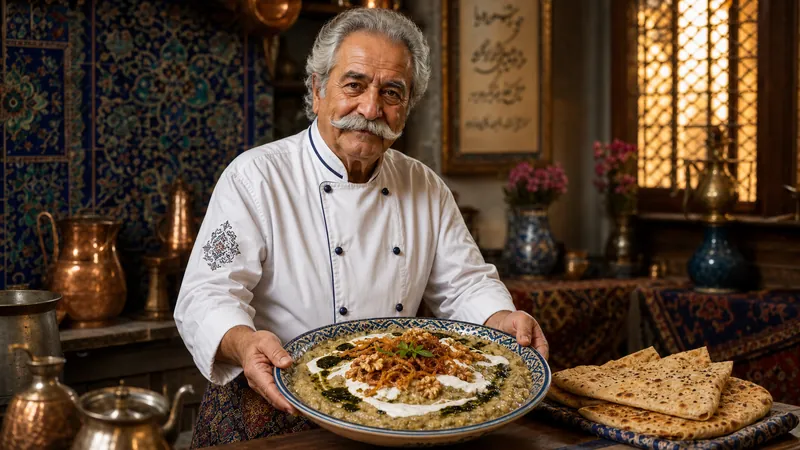
Silky eggplant with kashk, caramelized onion, garlic, mint, and walnuts
Eggplant is browned until tender, then slowly mashed with caramelized onion, garlic, and turmeric. Warm kashk adds a pleasantly tangy, savory finish, while fried mint and walnuts bring fragrance and texture.
Natural kitchen ambience accompanies this short film. Use the player controls to enable sound.
Across time and place
History & origin
Kashk-e bademjan is a well-known Iranian eggplant dish served warm as an appetizer, shared plate, or light meal with flatbread. Its final texture ranges from rustic to nearly smooth, and the garnish is traditionally part of both its flavor and presentation.
Across Iran
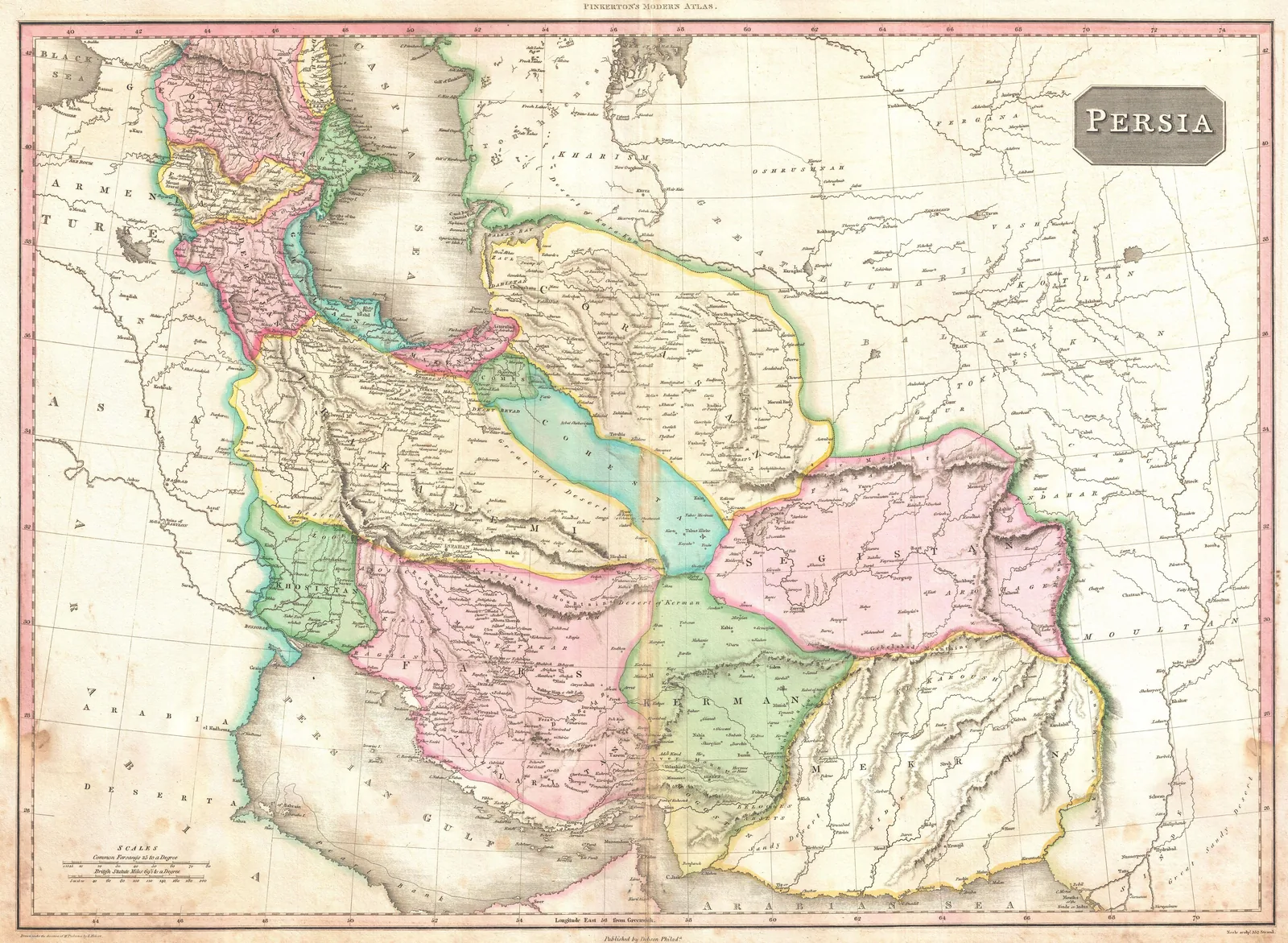
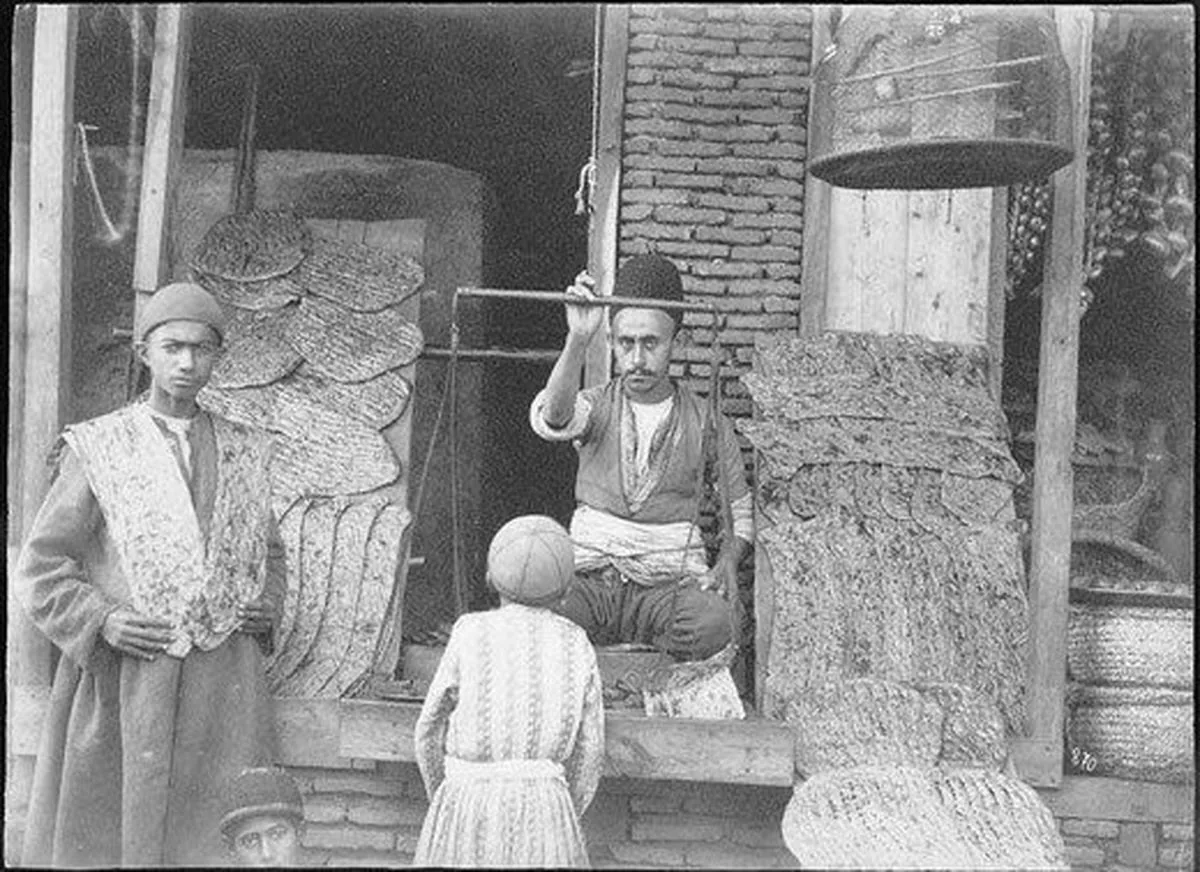
A hand-colored 1818 map by John Pinkerton. Historic borders and spellings reflect the map’s own period; the overlay is an editorial guide to the food story, not a territorial claim.John Pinkerton · Wikimedia Commons · Public domainAn Iranian naan bakery, circa 1850. The photograph is included as a window onto everyday Qajar foodways, not as a depiction of the finished dish.Unknown photographer · Wikimedia Commons · Public domain
⌖The marker indicates a broad Iranian culinary tradition—not a proven point of invention.
01
The historical trail
Kashk-e bademjan brings together two deeply established ingredients in Iranian foodways: eggplant and kashk, a preserved sour dairy product. Medieval Persian writing documents eggplant preparation, while later culinary records name the combined dish directly.
02
Place and tradition
Iranica traces eggplant from South Asia into Iranian lands at an early but undetermined date and records kashk among Iranian-speaking pastoral communities. Qajar dining accounts include kashk-e bademjan among shared side dishes, providing a firm nineteenth-century documentary anchor.
Before you begin
Ingredients
Every ingredient includes U.S. and metric quantities, buying guidance, preparation, and a practical substitution.
A visual guide to the principal ingredients; exact quantities appear below.
01Globe eggplants4 medium, about 2 1/2 lb/1.1 kg+
Why it mattersEggplant creates the dish’s mellow, creamy body once thoroughly cooked and mashed.
ChooseChoose firm, glossy eggplants that feel heavy and have fresh green caps.
PreparePeel, slice lengthwise 1/2 inch (1.25 cm) thick, salt lightly, rest 20 minutes, then blot dry.
SubstituteJapanese eggplants work well; use the same weight and shorten browning time as needed.
AllergenNo common major allergen; some people are individually sensitive to nightshades.
02Yellow onions2 large, thinly sliced/500 g+
Why it mattersSlow-browned onion supplies sweetness, savoriness, and the essential garnish.
ChooseChoose firm onions with dry skins and no sprouting.
PrepareSlice to an even thickness; reserve about one-third of the crisp onion for garnish.
SubstituteWhite onion works; shallots brown faster and taste slightly sweeter.
AllergenNo common major allergen; may not suit people sensitive to alliums.
03Garlic cloves6 large, thinly sliced/30 g+
Why it mattersGarlic gives the mash and garnish a warm, savory edge.
ChooseChoose firm cloves without green sprouts or soft spots.
PrepareSlice evenly and fry over moderate heat because thin garlic burns quickly.
SubstituteUse 1 1/2 teaspoons garlic paste in the mash, though it will not make a crisp garnish.
AllergenNo common major allergen; allium sensitivity is possible.
04Liquid kashk1 cup, divided/240 mL+
Why it mattersKashk, a fermented dairy product, adds characteristic tang, saltiness, and creamy depth.
ChooseChoose pasteurized kashk with a clean tangy aroma; salt levels vary by brand.
PrepareDilute thick kashk with a little water and bring it to a gentle simmer according to package directions before use.
SubstitutePlain full-fat yogurt can provide tang but is not kashk and should be stirred in off heat to reduce curdling.
AllergenContains milk; check the label because some prepared kashk may contain additional ingredients.
05Dried mint2 tbsp/8 g+
Why it mattersBriefly fried mint perfumes the eggplant and forms the classic na'na dagh garnish.
ChooseUse green, fragrant leaves rather than dull, dusty powder.
PrepareCrush lightly and fry for only seconds over low heat; it becomes bitter when burned.
SubstituteDried spearmint is ideal; fresh mint is a garnish, not a direct frying substitute.
AllergenNo common major allergen; individual mint sensitivity is possible.
06Ground turmeric1 1/2 tsp/4 g+
Why it mattersTurmeric warms the onion base and gives the mash a golden undertone.
ChooseChoose vivid, aromatic powder stored away from heat and light.
PrepareBloom briefly with the onion before adding eggplant.
SubstituteOmit if needed; curry powder is not an appropriate substitute.
AllergenNo common major allergen; inspect packaged spices for cross-contact.
07Neutral cooking oil1/2 cup, plus more only if needed/120 mL++
Why it mattersOil browns the eggplant and creates crisp onion, garlic, and mint garnishes.
ChooseUse a fresh neutral high-heat oil such as avocado, grapeseed, or canola.
PrepareMeasure into a small cup and add gradually; eggplant should brown, not float.
SubstituteMild olive oil may be used, but its flavor will be noticeable.
AllergenAllergen depends on the source oil; avoid oils tied to a known allergy.
08Walnut halves1/2 cup/60 g+
Why it mattersWalnuts add a mild earthy flavor and crunch against the soft eggplant.
ChooseChoose plump, pale kernels without a bitter or paint-like smell.
PrepareToast lightly, cool, and chop; reserve some for the top.
SubstituteOmit for a nut-free version or use toasted pumpkin seeds if appropriate.
AllergenContains walnut, a tree nut; packaged walnuts may contact other nuts or peanuts.
09Fine sea salt1 1/2 tsp, plus salt for draining eggplant/9 g++
Why it mattersSalt seasons and helps draw surface moisture from sliced eggplant.
ChooseUse fine salt for even distribution; kashk can already be quite salty.
PrepareWipe the draining salt away and season the finished mash only after tasting the kashk.
SubstituteUse another salt cautiously and adjust by taste.
AllergenNo common major allergen; seasoned salt blends may contain additives.
10Black pepper1/2 tsp, freshly ground/1.5 g+
Why it mattersPepper adds restrained warmth beneath the dairy and mint.
ChooseWhole peppercorns ground just before use have the freshest aroma.
PrepareAdd to the eggplant while it simmers.
SubstituteUse a smaller amount of white pepper if desired.
AllergenNo common major allergen; avoid inhaling freshly ground spice dust.
Step by step
Method
Equipment
Large skillet with lid
Medium skillet
Colander and tray
Potato masher or sturdy fork
Small saucepan
01
Salt the eggplant
Arrange sliced eggplant in a colander, sprinkle lightly with salt on both sides, and leave over a tray. Blot very dry; do not rinse unless heavily salted.
Time
20 minutes
Look for
Moisture beads on the surface and the slices bend slightly without feeling mushy.
02
Brown the eggplant
Heat a thin layer of oil in a large skillet over medium heat. Brown eggplant in batches without crowding, turning once and adding oil sparingly as needed. Transfer to a clean tray.
Time
5–7 minutes per batch
Look for
Both sides are golden-brown and a fork enters easily, but the slices still hold together.
03
Caramelize the onion
In a medium skillet, cook sliced onions in 3 tablespoons oil over medium-low heat, stirring often. When deep golden, transfer one-third to a paper-lined plate for garnish.
Time
18–22 minutes
Look for
Onions are evenly deep gold and sweet, with no black edges.
04
Fry the garlic
Push the remaining onion aside, add sliced garlic to the clear oil, and fry over medium-low heat. Remove half the garlic when pale gold and crisp for garnish.
Time
2–3 minutes
Look for
Garlic is pale gold, not brown; it will darken slightly after removal.
05
Bloom the turmeric
Stir turmeric into the onion and remaining garlic for 30 seconds, keeping the heat moderate.
Time
30 seconds
Look for
The oil turns golden and smells warm, with no scorched aroma.
06
Simmer and mash
Add browned eggplant, 1/2 cup (120 mL) water, and pepper. Cover and simmer over low heat, stirring and mashing every few minutes. Add a splash of water only if it catches.
Time
15–20 minutes
Look for
Eggplant has collapsed into a thick, spoonable mash and no watery liquid remains.
07
Toast and add walnuts
Toast walnuts in a dry skillet over medium-low heat, stirring, then cool and chop. Fold half into the eggplant and reserve half for garnish.
Time
4–5 minutes
Look for
Walnuts smell nutty and are one shade darker, not scorched.
08
Prepare and add the kashk
Warm the diluted, pasteurized kashk in a small saucepan to a gentle simmer as directed on its package. Stir 3/4 cup (180 mL) into the eggplant, lower the heat, and cook briefly. Taste before adding salt.
Time
5–7 minutes
Look for
The mixture is creamy and cohesive; the kashk is fully warm and does not sit in white streaks.
09
Make the mint oil
Warm 2 tablespoons oil over low heat. Remove the pan from direct heat, stir in dried mint for 15 to 20 seconds, then immediately transfer to a cool bowl.
Time
1 minute
Look for
Mint is fragrant and green-brown, never black.
10
Plate and garnish
Spread the hot eggplant on a shallow platter. Swirl over remaining warm kashk and mint oil, then finish with reserved onion, garlic, and walnuts. Serve with warm flatbread.
Time
5 minutes
Look for
The mash holds soft ridges from a spoon and the garnish remains distinct and crisp.
◌
Storage
Cool promptly and refrigerate the eggplant mixture in a covered shallow container for up to 3 days. Store crisp onion, garlic, and walnuts separately. Freezing is possible for up to 1 month, but the texture may soften.
↺
Reheating
Warm the eggplant gently in a covered saucepan with a tablespoon of water, stirring often, until it reaches 165°F (74°C). Warm the kashk separately and add fresh garnish after reheating.
✦
Variations
Roast lightly oiled eggplant at 425°F (220°C) until browned and tender for a lower-frying adaptation.
Leave the mash slightly chunky for a rustic texture or mash more thoroughly for a smooth presentation.
Omit walnuts for a nut-free version and increase the crisp onion garnish.
Food safety
Cook with care and judgment
Use pasteurized commercial kashk and follow its package directions; some products require boiling before service. Refrigerate the finished dish within 2 hours and reheat leftovers to 165°F (74°C).
Allergens
Contains milk from kashk and walnut, a tree nut.
Flatbread served alongside may contain wheat/gluten, sesame, milk, or other allergens; check separately.
Eggplant absorbs oil when the pan is cool or crowded. Dry it well, brown in a properly heated pan, and add measured oil gradually rather than pouring freely.
02Can I bake the eggplant instead of frying it?+
Yes. Brush lightly with oil and roast at 425°F (220°C), turning once, until well browned and completely tender. The flavor will be lighter but still balanced.
03What if my kashk is very salty or thick?+
Dilute it gradually with warm water and taste before seasoning the eggplant. Reserve some diluted kashk for the top instead of mixing all of it in.
04Can I make it one day ahead?+
Yes. Refrigerate the mash and garnishes separately, then reheat the mash and kashk thoroughly and add crisp garnishes just before serving.
Cooked by you
From your table
Share a photo of your dish and a note about how the recipe went. Every submission is reviewed before public display, and submission does not guarantee publication.