Persian date and walnut dessert

رنگینک

Ranginak

Walnut-filled dates beneath a golden blanket of toasted flour and butter

A small platter, soft dates, and a warm, nutty topping: this ranginak keeps the dates whole, tucks walnut pieces inside, and covers them with flour slowly cooked in butter and oil. Cinnamon and a little cardamom complete a rich dessert that needs no added sugar.

Prep
20 minutes
Cook
20 minutes
Total
About 1 hour
Serves
10 small servings, about 2 dates each
Difficulty
Easy
Share recipe
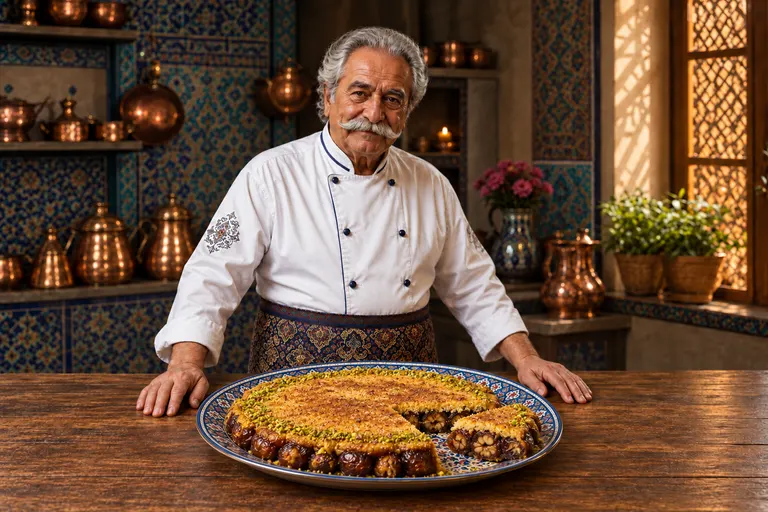
Ranginak — finished presentation

Watch the cooking film

A moment in the kitchen

Natural kitchen ambience accompanies this short film. Use the player controls to enable sound.

History & origins

The history of Ranginak

A date sweet remembered in southern homes

Southern Iran · a Bushehr account

Date palms in Bushehr, February 1925. A historical view of the southern landscape associated with Ranginak's date-based tradition, not a record of the dessert's invention.

Walter Mittelholzer / ETH-Bibliothek, Image Archive. Public domain, via Wikimedia Commons.
An archival photograph of tall date palms in a Bushehr grove.

An archival photograph of tall date palms in a Bushehr grove.

View the archive record & image license ↗

A Bushehr kitchen remembers

Southern Iranian cooks describe ranginak through the ingredients close at hand: soft dates, a little walnut, and flour cooked in fat. In a 2010 firsthand account, Chef Tayebeh describes making it since childhood and its familiarity across Bushehr province, while explicitly avoiding a claim that Bushehr alone owns its origin.

A southern tradition, more than one form

Shadi Hasanzadenemati likewise associates the dessert with southern Iran and records two approaches: walnut-stuffed whole dates or a spread of dates and walnuts, both covered with a toasted-flour topping. The choice here follows the first approach. The regional connection is well supported; an inventor, first city, and precise creation date are not established.

A hand-colored 1818 map by John Pinkerton. Historic borders and spellings reflect the map’s own period; the overlay is an editorial guide to culinary geography, not a territorial claim.

Bushehr represents a documented southern household tradition, not an exclusive birthplace.

John Pinkerton · Wikimedia Commons · Public domain
John Pinkerton's hand-colored 1818 map of Persia and surrounding regions

John Pinkerton's hand-colored 1818 map of Persia and surrounding regions

View the archive record & image license ↗

With tea or at iftar

Ranginak belongs especially to the date-rich tables of southern Iran. It can accompany tea or an iftar meal, but the arrangement, fat, spices, and decoration vary between homes. This is the walnut-stuffed date version, not the alternative made with a flattened date mixture.
Before you begin

Ingredients

Every ingredient includes U.S. and metric quantities, buying guidance, preparation, and a practical substitution.

Ranginak — ingredient table
The ingredient photograph shows dates, walnuts, flour, butter, neutral oil, cinnamon, cardamom, and optional pistachios. No sugar, syrup, coconut, or rose petals are needed for this version.
01Soft Medjool dates20 large dates, pitted About 400 g after pitting

Why it mattersThe dates form the sweet, soft base; no extra sugar is needed.

ChooseChoose plump, pliable dates with no mold, insects, or fermented smell. The exact number depends on their size.

PrepareRemove any stem caps. Slit each date along one side and remove the whole pit; inspect the inside and feel carefully for fragments.

SubstituteSoft Iranian dates or rotab work; use roughly the same pitted weight and enough to fill one snug layer. Very dry dates are harder to stuff neatly.

AllergenCheck packaged dates for added ingredients or shared-equipment warnings. Pits and pit fragments are a choking and dental hazard.

02WalnutsAbout 1/2 cup pieces 60 g

Why it mattersWalnut pieces give the soft dates a gently crunchy center.

ChooseUse fresh walnuts with a clean, mild smell; discard rancid or moldy nuts.

PrepareInspect for shell fragments and break into pieces small enough to fit inside the dates.

SubstituteFor a version without added nuts, omit both walnuts and the optional pistachios. It will be softer; use ingredients and utensils suitable for the guest's allergy needs.

AllergenWalnuts are a tree-nut allergen.

03All-purpose wheat flour1 cup, spooned and leveled 120 g

Why it mattersSlow cooking turns flour and fat into the golden, nutty-tasting covering.

ChooseUse plain flour without baking powder; weigh it for the most consistent coating.

PrepareSift before adding to the pan. Keep raw flour away from the ready-to-eat dates and do not taste it uncooked.

SubstituteWhole-wheat flour gives a darker, coarser coating and may need a little more fat. This version has not been developed with gluten-free flour.

AllergenContains wheat and gluten.

04Unsalted butter6 tbsp 85 g

Why it mattersButter gives the coating richness and helps it firm as the dessert cools.

ChooseUse fresh unsalted butter, not a low-fat spread.

PrepareCut into small pieces so it melts evenly over gentle heat.

SubstituteGhee gives a different aroma and still contains milk-derived ingredients; it is not an automatic substitute for a milk allergy.

AllergenContains milk.

05Neutral cooking oil3 tbsp 45 mL

Why it mattersOil keeps the cooked-flour coating fluid enough to spread over the dates.

ChooseChoose a fresh, mild oil intended for cooking, such as canola or sunflower.

PrepareMeasure before heating and keep the pan below the smoking point.

SubstituteAnother neutral cooking oil is suitable. Strong olive oil changes the flavor.

AllergenCheck the source and label, particularly if avoiding soy or nut oils.

06Ground cinnamon1 tsp, divided About 2.5 g, divided

Why it mattersCinnamon connects the caramel-like dates with the toasted-flour layer.

ChooseChoose finely ground cinnamon with a fresh aroma.

PrepareUse half in the cooked coating and sift the other half lightly over the top.

SubstituteReduce to 1/2 tsp for a gentler spice flavor; do not replace with cinnamon essential oil.

AllergenCheck spice blends for extra ingredients and cross-contact.

07Ground green cardamom1/4 tsp About 0.5 g

Why it mattersA small amount adds a floral note without masking the dates.

ChooseUse finely ground cardamom seeds, not chopped whole pods.

PrepareStir into the coating after taking the pan off the heat.

SubstituteOmit if preferred; cinnamon alone also suits ranginak.

AllergenCheck packaged spices and avoid any ingredient to which you are individually allergic.

08Unsalted pistachios, optional2 tbsp, finely chopped 15 g

Why it mattersPistachio adds a restrained green finish; it is decoration, not a structural ingredient.

ChooseChoose fresh shelled pistachios without shell fragments.

PrepareChop finely and sprinkle around the edge after the coating has cooled slightly.

SubstituteOmit entirely; no replacement garnish is needed.

AllergenPistachios are a tree-nut allergen.

Step by step

Method

Equipment

  • Shallow heat-safe serving dish, about 8 inches (20 cm) wide
  • Heavy skillet, ideally with a light-colored interior
  • Small knife and a stable cutting board
  • Sieve and a heat-resistant spatula
  • Kitchen scale or measuring cups and spoons
  1. 01

    Inspect and pit the dates

    Wash your hands and set the serving dish on a stable surface. Remove stem caps, slit the dates on one side, and pull out every pit. Check inside each date for pit fragments or spoilage. If the dates need rinsing according to their packaging, dry them thoroughly before continuing.

    Time
    8 minutes
    Look for
    Every date is soft, clean, dry on the surface, and completely free of pits.
  2. 02

    Fill and arrange one close layer

    Check the walnuts for shell fragments. Tuck one or two small pieces into each date, sharing all 60 g among the dates, and gently press the slit together. Arrange them snugly in one layer in the heat-safe dish. Measure and sift the flour, and measure the fats and spices before turning on the heat.

    Time
    10 minutes
    Look for
    The dates sit together without overlapping, with walnut pieces enclosed rather than piled on top.
  3. 03

    Cook the flour slowly in the fats

    Warm the butter and oil in the skillet over medium-low heat. Add the sifted flour and stir continuously, scraping the base and corners, for about 15–20 minutes. Adjust the heat so the mixture cooks steadily without smoking. It should become an even deep golden color, like toasted biscuit, with no pale flour pockets. If black flecks or an acrid smell develop, discard the burnt coating and start again.

    Time
    15–20 minutes
    Look for
    The coating is glossy and evenly golden, with a toasted aroma. Color is a cooking cue, not a reason to taste uncooked flour.
  4. 04

    Add spice and cover the dates

    Take the pan off the heat. Stir in the cardamom and 1/2 tsp cinnamon. Let the vigorous bubbling subside for about 1 minute, then carefully spoon the hot coating over the dates. Use the back of the spoon to cover gaps and smooth the surface; keep fingers well away from the hot fat.

    Time
    3 minutes
    Look for
    The date layer is covered by a thin, continuous golden coating rather than a tall cake-like layer.
  5. 05

    Let the platter settle

    Leave the dish on a heatproof surface for about 20 minutes, away from children. After the first 10 minutes, sift the remaining 1/2 tsp cinnamon lightly over the top and add the optional finely chopped pistachios. The coating should settle enough to stay on the dates, but it does not need to become hard.

    Time
    20 minutes
    Look for
    The topping has lost its very hot sheen and holds a gentle spoon mark; the dates remain soft.
  6. 06

    Serve in small portions

    Serve comfortably warm or at room temperature, allowing about two dates per person. Lift each portion with a small spoon or fork so it includes date, walnut, and topping. Offer plain tea alongside if wanted, and refrigerate leftovers promptly rather than leaving the platter out all afternoon.

    Time
    2 minutes
    Look for
    Each bite is soft and rich with a small walnut crunch; the topping is pleasantly warm, never scalding.

Storage

Cover and refrigerate at 40°F (4°C) or below within 2 hours, or within 1 hour in temperatures above 90°F (32°C). Use within 4 days as a conservative home-storage limit. Keep portions covered so the dates do not dry out and the butter does not absorb refrigerator odors.

Reheating

No reheating is necessary. Let only the portion you will eat stand for about 15–20 minutes so the butter softens, keeping the rest refrigerated. Avoid microwaving whole stuffed dates: the centers can become much hotter than the surface.

Variations

  • Use soft Iranian dates or rotab by pitted weight; smaller fruit means more dates in the same single layer.
  • Leave out the cardamom for a cinnamon-led finish, or reduce the cinnamon to 1/2 tsp in total.
  • For individual portions, arrange two filled dates in each of ten small heat-safe dishes and share the cooked coating equally.

Food safety

Cook with care and judgment

Remove every date pit and walnut-shell fragment. Raw flour is not ready to eat: keep it separate from the prepared dates, cook the coating fully, and clean hands, utensils, and work surfaces after handling flour. Hot butter and oil can cause serious burns; keep the pan stable, stir with a long heat-resistant tool, and never leave it unattended. Whole nuts and sticky dates may be unsuitable for young children or people with swallowing difficulties.

Allergens

  • Contains wheat/gluten, milk, and walnuts. Optional pistachios add another tree nut.
  • No egg is intentionally added. Check dates, oils, spices, and shared utensils for other allergens; omitting a garnish alone does not make the dessert safe for a nut allergy.
Full safety guidance and terms

Good to know

Frequently asked questions

01Does ranginak need added sugar?

Not this version. The dates provide the sweetness. Some households decorate with sugar, but it is not needed for the structure or the method here.

02Why is the coating too pale?

The flour may not have cooked long enough, or the heat may be too low. Continue stirring over controlled medium-low heat until evenly golden. Do not raise the heat sharply; flour and butter can scorch quickly.

03Should ranginak slice like a cake?

This whole-date version is served by lifting filled dates with their topping. It is not designed as a tall, firm cake. The coating firms more when refrigerated and softens again at room temperature.

04Can I use very dry dates?

Soft dates work better because they open without breaking and close around the nuts. Choose a softer variety rather than adding water to the finished platter; added moisture changes both texture and storage.

05Can I make it a day ahead?

Yes. Cover and refrigerate promptly, then let the serving portion soften briefly before eating. Keep within the 4-day refrigerated storage limit and avoid leaving the full dish out repeatedly.

Cooked by you

From your table

Share a photo of your dish and a note about how the recipe went. Every submission is reviewed before public display, and submission does not guarantee publication.

No public profileNo name or email requested
Recipe tagRanginakAutomatic
Dish photoRequired
10–420 characters0 / 420

I accept the Community Submission Terms and Privacy Policy.

Do not include faces, phone numbers, addresses, documents, or private information. Comments are received as plain text, and nothing is published automatically.