Soft white rice simmered in milk, with rosewater and sweetness served on the side
A quiet, creamy pudding made from rice, milk, and a little rosewater. The rice softens in water before the milk goes in; gentle stirring then brings the mixture together. Leave the base unsweetened and offer honey or date syrup separately so each bowl can be finished to taste.
Prep
5 minutes
Cook
About 1 hour 5 minutes
Total
About 1 hour 10–20 minutes; add 2 hours if serving chilled
Natural kitchen ambience accompanies this short film. Use the player controls to enable sound.
Across time and place
History & origin
Shir means milk and berenj means rice. Families serve this familiar Iranian dish in different ways, from a simple breakfast to a small dessert. Some sweeten the pot; others leave it plain and add syrup, honey, or preserves at the table. This version follows the latter approach.
Across Iran
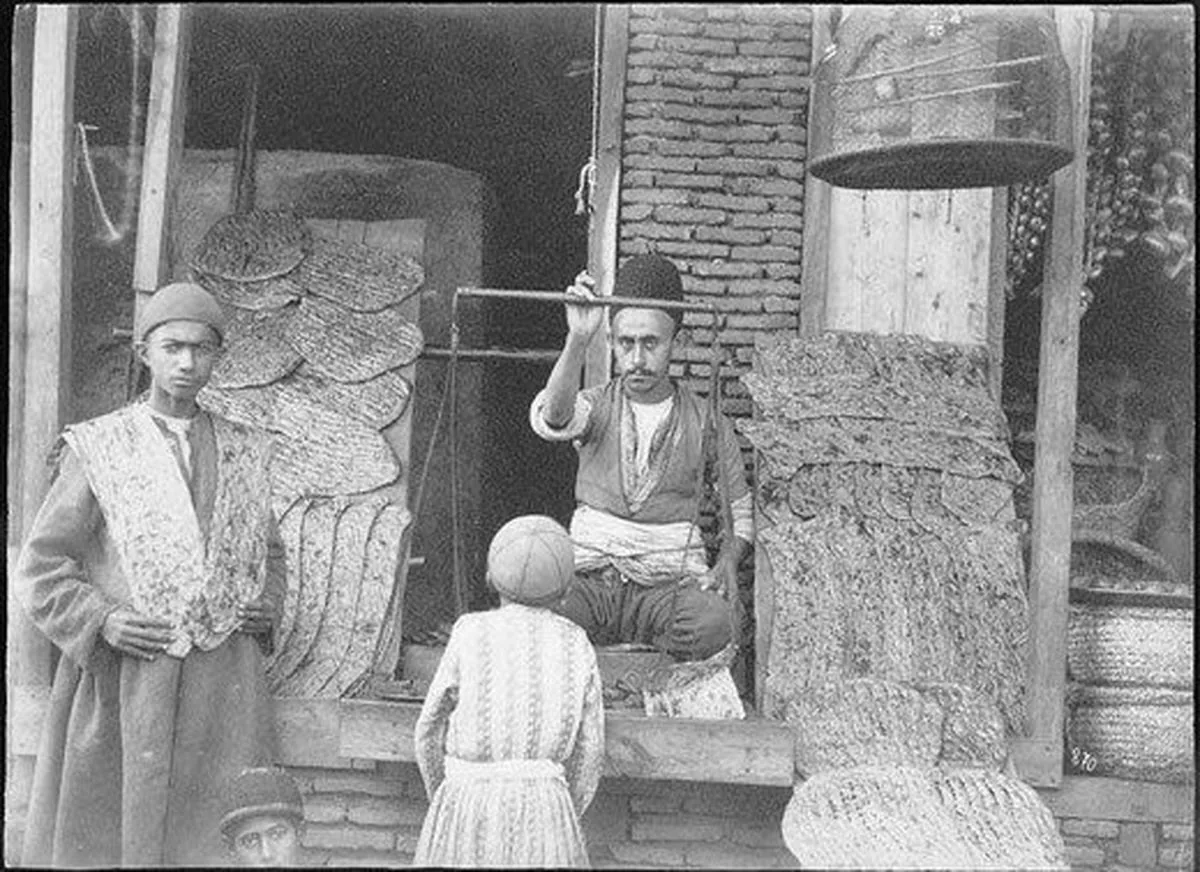
A hand-colored 1818 map by John Pinkerton. Historic borders and spellings reflect the map’s own period; the overlay is an editorial guide to the food story, not a territorial claim.John Pinkerton · Wikimedia Commons · Public domainAn Iranian naan bakery, circa 1850. The photograph is included as a window onto everyday Qajar foodways, not as a depiction of the finished dish.Unknown photographer · Wikimedia Commons · Public domain
⌖The marker indicates a broad Iranian culinary tradition—not a proven point of invention.
01
The historical trail
Iranica records shirberenj among Iranian rice preparations and describes milk and aromatic flavorings, with grape syrup as one accompaniment. That documentation places it within Iranian cooking without identifying a single inventor or birthplace.
02
Place and tradition
Contemporary accounts by Iranian cooks Homa and Azita Mehran show different household choices for sweetness and toppings. The unsweetened base here is one such approach, not a claim that every Iranian family prepares the dish identically. Honey and date syrup are serving choices for this recipe.
Before you begin
Ingredients
Every ingredient includes U.S. and metric quantities, buying guidance, preparation, and a practical substitution.
The pudding stays white: no saffron, cream, or nuts are used. Cinnamon and honey or date syrup are optional serving accompaniments; the syrup is shown separately, not mixed into the pot.
01Short- or medium-grain white rice1/2 cup/100 g+
Why it mattersIts starch gives the pudding body without flour or eggs.
ChooseChoose plain Calrose, sushi rice, or Iranian broken rice; avoid instant or parboiled rice.
PrepareCheck for debris, rinse briefly in a sieve, and drain. No overnight soak is needed for this method.
SubstituteWhite basmati can be used by weight, but may take longer to break down and give a less creamy texture. Brown rice needs a different cooking schedule.
AllergenPlain rice has no common major allergen; check blends and shared packing equipment when relevant.
02Water1 1/2 cups, plus a little if needed/360 mL, plus a little if needed+
Why it mattersWater softens the rice before dairy is added, reducing the risk of scorching during that first stage.
ChooseUse fresh drinking water.
PrepareMeasure into the pot with the rinsed rice; keep a little extra hot water available if the rice dries before softening.
SubstituteFiltered drinking water is suitable. Do not replace the initial water with more milk in this method.
AllergenWater contains no food allergen.
03Whole milk4 cups/960 mL+
Why it mattersMilk supplies the soft white color and rounded dairy flavor; the pudding thickens further as it cools.
ChooseUse pasteurized plain whole milk, kept refrigerated and within its use-by guidance.
PrepareMeasure before cooking. Add in two portions, stirring well around the bottom and corners of the pan.
SubstituteUse 2% milk for a lighter texture or lactose-free whole cow's milk in the same amount. Lactose-free dairy is not suitable for milk allergy.
AllergenContains milk. Plant-based substitutes may introduce soy or tree nuts and change the texture.
04Culinary rosewater1 tbsp/15 mL+
Why it mattersA restrained floral finish keeps the milk and rice at the center.
ChooseChoose food-grade distilled rosewater, not cosmetic rosewater, essential oil, or concentrated essence.
PrepareAdd near the end of cooking. If your rosewater is particularly strong, start with 2 teaspoons (10 mL).
SubstituteOmit for a plain milk-and-rice pudding; do not substitute rose essential oil.
AllergenCheck the label for additives and any individual sensitivity to rose products.
05Fine salt1/8 tsp/0.75 g+
Why it mattersA small pinch balances the milk's flavor without making the pudding salty.
ChooseUse plain fine salt; coarser crystals occupy a different volume.
PrepareAdd with the initial rice and water.
SubstituteReduce or omit to suit your needs.
AllergenPlain salt has no common major allergen.
06Ground cinnamon, optional1/4 tsp, for serving/0.5 g+
Why it mattersA light dusting offers a warm contrast to the pale pudding.
ChooseChoose fresh plain ground cinnamon, not a sweetened spice mixture.
PrepareDivide lightly over the bowls just before serving, or pass separately.
SubstituteOmit for a completely plain white surface.
AllergenCheck spice labels and individual sensitivities.
07Honey or date syrup, optional1/4 cup, served separately/60 mL+
Why it mattersServing the sweetener separately lets everyone choose how much to add.
ChooseChoose plain honey or food-grade date syrup with a clear ingredient label; select one, not both.
PreparePour into a small serving jug. Do not stir it into the cooking pot.
SubstituteGrape syrup or a little fruit preserve can be offered instead. Toppings are optional; the base has no added sweetener.
AllergenCheck syrup ingredients. Never give honey to a child younger than 12 months, even mixed into food.
Step by step
Method
Equipment
Heavy-bottomed 3-quart (3 L) saucepan
Fine-mesh sieve and measuring jug
Flexible spatula or wooden spoon
Six small heat-safe serving bowls
Food thermometer for reheating
01
Rinse and measure
Rinse and drain the rice. Put it in the heavy saucepan with 1 1/2 cups (360 mL) water and the salt. Measure the milk separately so it is ready when the rice softens.
Time
5 minutes
Look for
The rice is clean and the liquids are measured; there is no need to soak overnight.
02
Soften the rice thoroughly
Bring the rice and water to a gentle boil over medium heat, then reduce to low. Simmer uncovered for 20–25 minutes, stirring occasionally. Press a few grains against the pan with the spoon: they should crush easily. If the pot dries while the centers are firm, add hot water 2 tablespoons (30 mL) at a time and continue.
Time
About 25–30 minutes including heating
Look for
The grains are swollen, beginning to break apart, and surrounded by a little starchy liquid; no hard centers remain.
03
Stir in the milk gradually
Stir in half the milk and bring back to a gentle simmer. Add the rest and cook uncovered over low heat for 30–35 minutes, stirring frequently and sweeping the bottom and corners. Stir almost continuously as it thickens. Lower the heat if a skin catches at the edge or the milk foams upward; do not let it boil hard.
Time
30–35 minutes
Look for
The milk and softened rice form one creamy mixture that lightly coats the spoon. It is still looser than the final chilled pudding, not a firm paste.
04
Finish with rosewater
Stir in the rosewater and simmer gently for 3 minutes. Remove from the heat. If the mixture has become too stiff to flow from a ladle, loosen it with a little extra milk and bring back to a gentle simmer before removing. Do not add saffron; this is a white milk pudding.
Time
3 minutes
Look for
The aroma is gently floral and the pudding pours in a thick ribbon, with very soft rice visible.
05
Portion and choose warm or chilled
Divide among six small heat-safe bowls. Serve warm after it has cooled enough to eat safely, or cool promptly and refrigerate, ideally within 1 hour of cooking. For chilled pudding, allow about 2 hours in the refrigerator. Do not leave the full pot on the counter to cool completely.
Time
2 minutes to portion; optional 2 hours chilling
Look for
Warm pudding is soft and flowing; chilled pudding is thicker but still spoonable, not sliceable.
06
Let everyone finish their bowl
Offer the optional cinnamon and a small jug of honey or date syrup separately. Start with a little sweetener and add more only if wanted. The rice and milk should remain the main flavors.
Time
1 minute
Look for
The surface remains pale with, at most, a light cinnamon dusting; sweetness is adjusted individually.
◌
Storage
Cool in small, shallow portions and refrigerate promptly, ideally within 1 hour. Keep covered at 40°F (4°C) or below and eat within 24 hours; this follows conservative cooked-rice guidance. Discard pudding left out longer than 2 hours, or 1 hour above 90°F (32°C). Freezing is not recommended for the best texture.
↺
Reheating
Cold pudding can be eaten straight from the refrigerator if stored correctly. To serve warm, reheat only the portion needed with a splash of milk, stirring over low heat until every part reaches 165°F (74°C). Reheat rice only once, then let the portion cool to a comfortable eating temperature. Reheating does not make improperly stored rice safe.
✦
Variations
For a less floral bowl, use 2 teaspoons (10 mL) rosewater or leave it out.
Replace the honey or date syrup at serving with grape syrup; its darker color belongs on top or on the side, not in the white base.
Use 2% milk for a lighter result; keep the same slow cooking method and judge thickness rather than extending the time automatically.
Food safety
Cook with care and judgment
Use pasteurized milk. Rice can contain spores that survive cooking, so prompt cooling matters; smell alone cannot confirm safety. Handle bubbling milk and hot bowls carefully. Never give honey to children younger than 12 months, and keep honey off any portion intended for them.
Allergens
Contains milk. Lactose-free cow's milk still contains milk proteins.
No eggs, wheat, or nuts are intentionally added to this version; check packaged ingredients, substitutions, and shared utensils.
No. This shir berenj is white and milk-based. Sholeh zard is a different rice dessert colored and flavored with saffron, usually cooked with water rather than milk.
02Why is there no sugar in the pot?+
Leaving the base plain lets each person add honey or syrup to taste. Sweetened-pot versions also exist; this is a deliberate household-style choice, not a rule for every shir berenj.
03Why did the pudding become too thick in the refrigerator?+
Rice keeps absorbing liquid as it cools. Stop cooking while the pudding is a little loose. For an already firm chilled batch, stir in a small splash of pasteurized milk; follow the reheating guidance if warming it.
04What if the bottom starts to scorch?+
Take it off the heat. Transfer the unburnt top portion to a clean saucepan without scraping the browned bottom, then continue over lower heat. A strongly burnt flavor cannot be repaired with extra rosewater.
05Can I make it the day before?+
Yes, provided you cool it promptly, refrigerate at 40°F (4°C) or below, and serve within 24 hours of cooking. Add the optional cinnamon and sweetener at serving.
Cooked by you
From your table
Share a photo of your dish and a note about how the recipe went. Every submission is reviewed before public display, and submission does not guarantee publication.