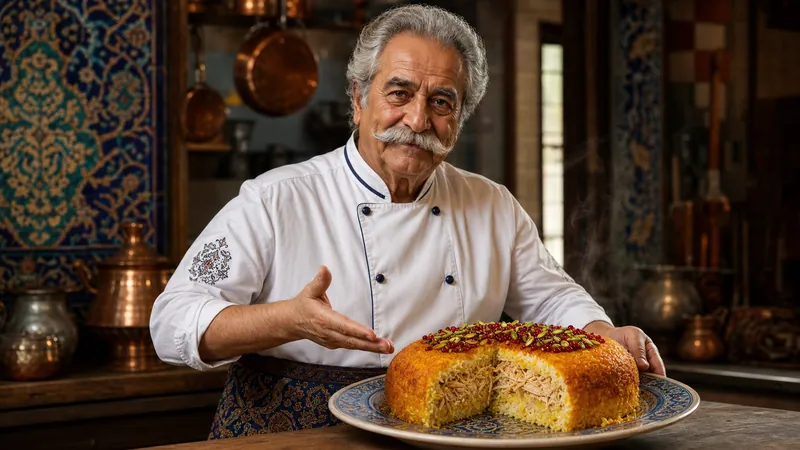
Saffron yogurt rice cake layered with tender chicken
Parboiled basmati rice is folded into a saffron, yogurt, and egg-yolk custard, layered with seasoned chicken, and baked until the base and sides form a deeply golden crust. The finished tahchin is crisp outside, fragrant and tender within.
Natural kitchen ambience accompanies this short film. Use the player controls to enable sound.
Across time and place
History & origin
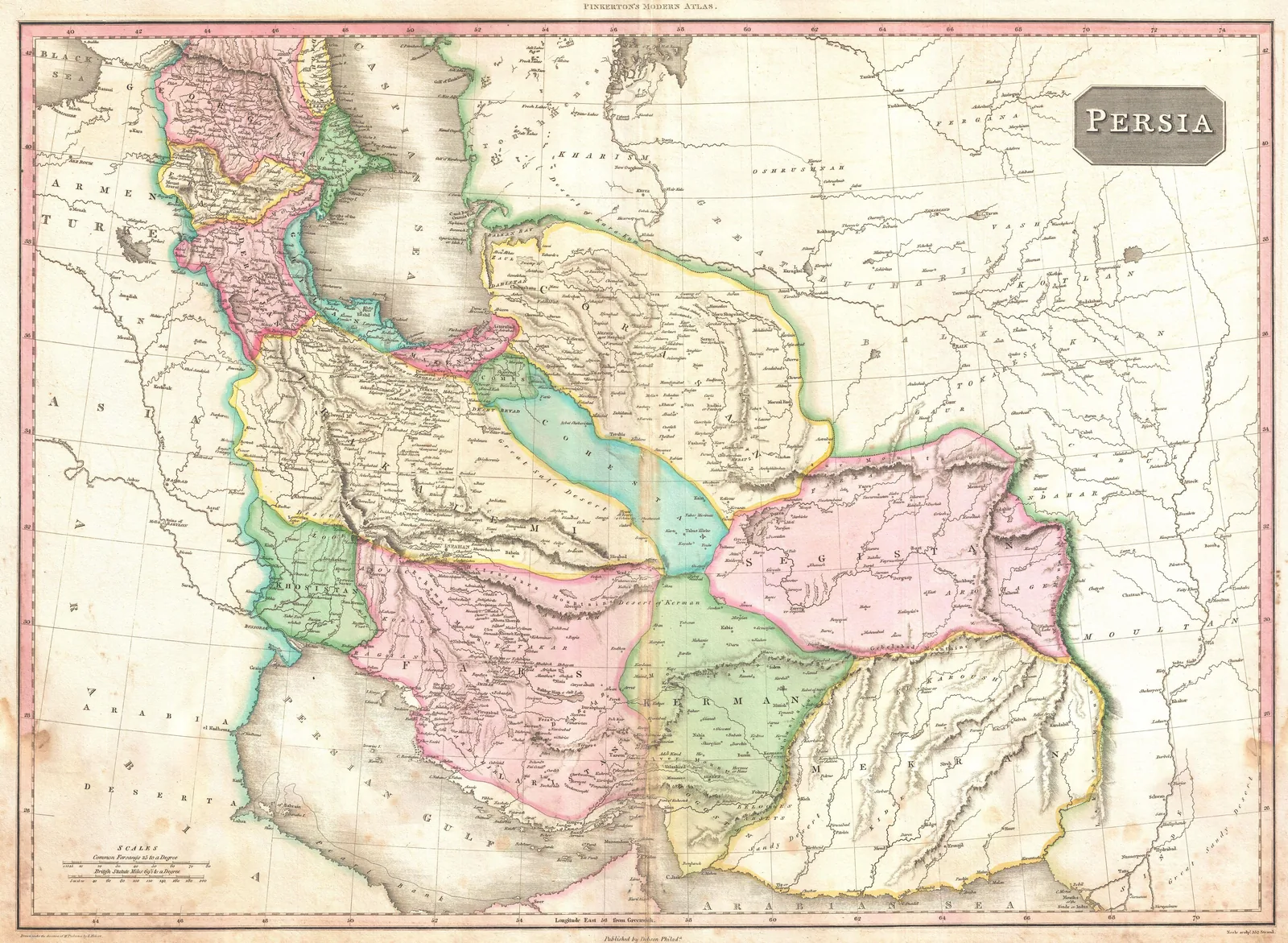
Tahchin is a celebratory Persian rice dish prized for the contrast between its saffron-scented interior and crisp golden crust. It may be made in a deep casserole or as a thinner tray-style rice cake; chicken is among the most familiar fillings.
⌖The marker indicates a broad Iranian culinary tradition—not a proven point of invention.
01
The historical trail
Tahchin-e morgh belongs to the Iranian tahchin family; its name refers to ingredients arranged at the bottom of the cooking vessel. Historical references describe rice bound with yogurt, saffron, and egg, with chicken, meat, spinach, fish, and vegetable variations.
02
Place and tradition
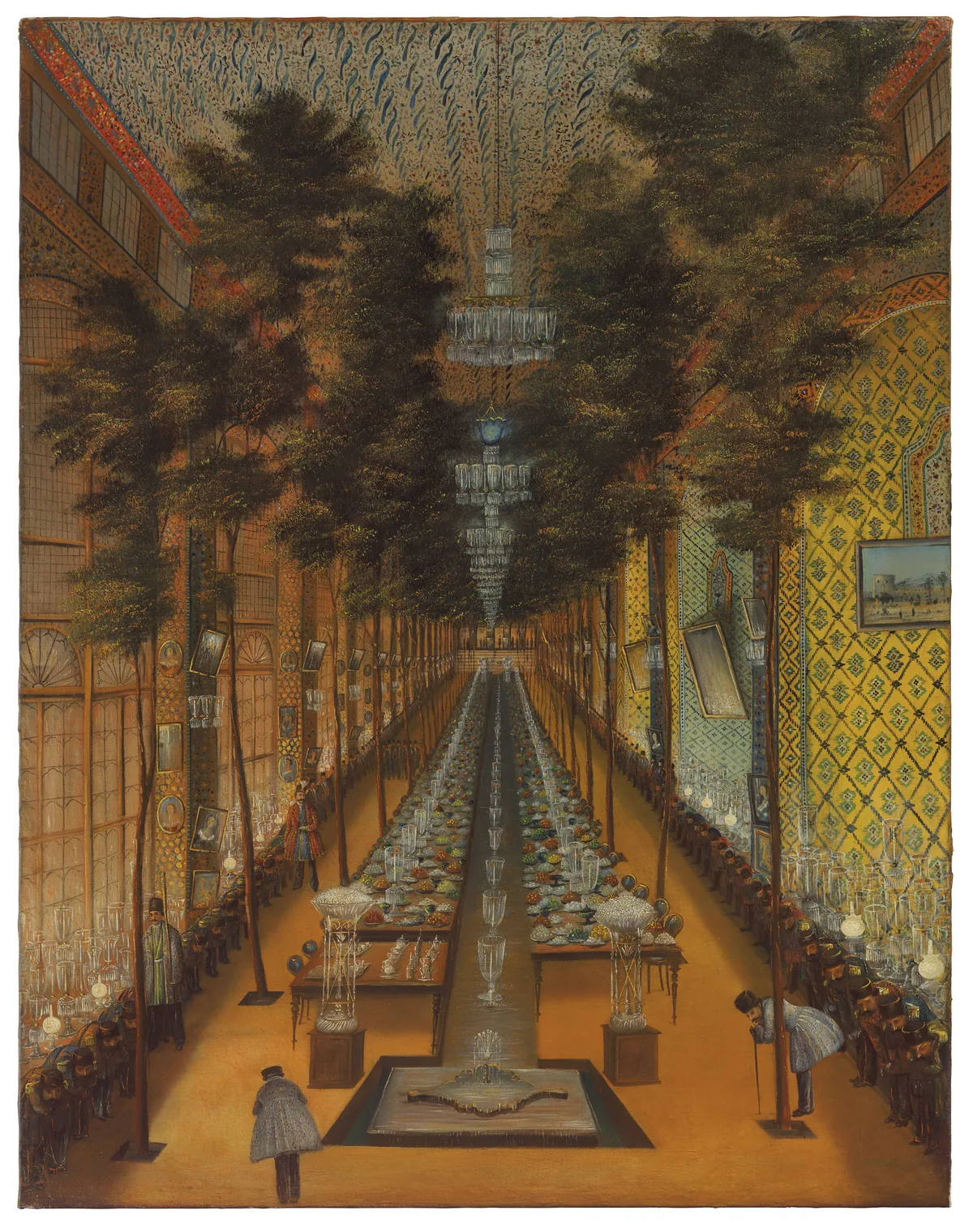
The elaborate washing, soaking, parboiling, and steaming techniques of Persian rice cookery were recorded especially clearly during the Qajar period. That tradition gives tahchin important historical context without proving a court invention.
Before you begin
Ingredients
Every ingredient includes U.S. and metric quantities, buying guidance, preparation, and a practical substitution.
A visual guide to the principal ingredients; exact quantities appear below.
01Aged basmati rice2 1/2 cups/500 g+
Why it mattersLong-grain rice creates distinct, light grains above a compact crisp crust.
ChooseChoose fragrant, intact grains; aged basmati generally expands more evenly.
PrepareRinse until the water is nearly clear, then soak in salted water for 30 minutes.
SubstituteA high-quality Persian long-grain rice may be used with the same weight.
AllergenNo common major allergen; verify packaged rice if cross-contact is a concern.
02Boneless skinless chicken thighs1 1/2 lb/680 g+
Why it mattersThigh meat remains moist during the chicken’s first cook and the final bake.
ChooseChoose evenly sized pieces with a fresh color and no strong odor.
PrepareTrim excess fat; keep refrigerated until ready to cook.
SubstituteChicken breast works, but remove it from heat promptly at 165°F (74°C) to limit drying.
AllergenNo common major allergen; raw poultry requires strict separation from ready-to-eat foods.
03Yellow onion1 medium, sliced/180 g+
Why it mattersOnion perfumes the poaching liquid and gently seasons the chicken.
ChooseChoose a firm onion with tight, papery skin.
PrepareSlice into even half-moons so it softens at the same rate.
SubstituteTwo large shallots provide a softer alternative.
AllergenNo common major allergen; allium sensitivity is possible.
04Saffron threads1/2 tsp, loosely packed/0.35 g+
Why it mattersBloomed saffron provides tahchin’s golden color and defining floral aroma.
ChooseChoose deep-red threads with a strong aroma and minimal yellow style.
PrepareGrind with a pinch of sugar or salt, then steep in 1/4 cup (60 mL) hot, not boiling, water for 10 minutes.
SubstituteThere is no equivalent substitute; turmeric colors the rice but does not reproduce saffron’s aroma.
AllergenNo common major allergen; purchase from a reputable source to avoid adulterated spice.
05Plain whole-milk yogurt1 1/2 cups/360 g+
Why it mattersYogurt tenderizes the rice mixture and helps form a cohesive, tangy crust.
ChooseUse thick, unsweetened yogurt without added flavors.
PrepareBring near room temperature for 15 minutes and whisk smooth.
SubstituteLactose-free plain dairy yogurt works; a thick unsweetened plant yogurt changes the flavor and browning.
AllergenContains milk.
06Large egg yolks3/54 g (3)+
Why it mattersYolks bind the rice and enrich the browned crust without making it rubbery.
ChooseUse clean, uncracked refrigerated eggs.
PrepareSeparate carefully so little or no white enters the custard.
SubstituteTwo whole large eggs can bind the dish, but the interior will be firmer.
AllergenContains egg.
07Neutral cooking oil1/2 cup, divided/120 mL+
Why it mattersOil coats the pan, keeps the rice tender, and supports an evenly crisp shell.
ChooseChoose fresh avocado, grapeseed, sunflower, or canola oil.
PrepareUse part in the custard and brush the remainder generously over the pan.
SubstituteMild olive oil is usable but adds a distinct flavor.
AllergenAllergen depends on source oil; choose one appropriate for diners.
08Unsalted butter3 tbsp, melted/42 g+
Why it mattersButter adds aroma and encourages deep browning at the edges.
ChooseUse fresh unsalted butter so the final salt level remains controllable.
PrepareMelt gently; do not brown before adding.
SubstituteUse the same amount of neutral oil for a dairy-free adaptation.
AllergenContains milk.
09Fresh lemon juice2 tbsp/30 mL+
Why it mattersLemon lightly brightens the chicken and balances the rich rice custard.
ChooseChoose a heavy, thin-skinned lemon for more juice.
PrepareStrain out seeds before mixing with the chicken.
SubstituteUse 1 tablespoon verjuice for a softer Persian-style acidity.
AllergenNo common major allergen.
10Fine sea salt2 tbsp for rice water, plus 2 tsp divided/30 g + 12 g+
Why it mattersSalt seasons the rice water, chicken, and custard at separate stages.
ChooseFine salt distributes evenly; salt crystal density varies by brand.
PrepareMost salt goes into the boiling water and is drained away; divide the rest as directed.
SubstituteUse another salt by taste and weight where possible.
AllergenNo common major allergen; check flavored salt blends.
11Ground turmeric1 tsp/3 g+
Why it mattersTurmeric seasons and colors the chicken without competing with the saffron rice.
ChooseUse fragrant, vivid powder kept away from light.
PrepareStir into the onion before adding chicken.
SubstituteOmit if unavailable; do not replace with curry powder.
AllergenNo common major allergen; review packaged-spice cross-contact labels.
12Black pepper1/2 tsp/1.5 g+
Why it mattersPepper adds gentle warmth to the chicken layer.
ChooseFreshly ground pepper has the cleanest aroma.
PrepareAdd with turmeric and salt.
SubstituteUse a smaller amount of white pepper if preferred.
AllergenNo common major allergen; avoid inhaling spice dust.
13Dried barberries1/2 cup/75 g+
Why it mattersBarberries provide bright, tart jewels against the rich saffron rice.
ChooseChoose plump, vivid red berries with no damp clumps.
PreparePick over, rinse briefly in cool water, and dry; sauté only briefly to prevent burning.
SubstituteOmit, or use a small amount of dried cranberries for a sweeter nontraditional garnish.
AllergenNo common major allergen; check sweetened packaged fruit for additives.
14Slivered pistachios1/4 cup/30 g+
Why it mattersPistachios add color and a delicate crunch to the finished dish.
ChooseChoose fresh green slivers without a stale or paint-like odor.
PrepareUse as a garnish after unmolding so it stays crisp.
SubstituteOmit for a nut-free dish or use toasted pumpkin seeds if suitable.
AllergenContains pistachio, a tree nut; packaged nuts may contact other tree nuts or peanuts.
Step by step
Method
Equipment
9 x 13-inch metal baking pan or 3-quart casserole
Large pot and fine colander
Medium saucepan with lid
Large mixing bowl
Instant-read thermometer
01
Bloom the saffron
Grind the saffron to a fine powder, pour over 1/4 cup (60 mL) hot water, cover, and set aside.
Time
10 minutes
Look for
The liquid is deep orange-red and strongly fragrant.
02
Cook the chicken
Cook the onion in 1 tablespoon oil over medium heat until softened. Add turmeric and pepper for 30 seconds, then add chicken, 1 teaspoon salt, lemon juice, and 1 cup (240 mL) water. Cover and simmer gently, turning once.
Time
25–35 minutes
Look for
The thickest piece reaches 165°F (74°C); juices run clear and the meat pulls apart easily.
03
Cool and shred
Transfer the cooked chicken to a clean plate. When cool enough to handle, shred into bite-size pieces and moisten with 3 tablespoons of the strained cooking liquid.
Time
10 minutes
Look for
Chicken is moist but no liquid pools on the plate.
04
Parboil the rice
Bring a large pot of water to a rolling boil with the rice-water salt. Drain the soaked rice, add it, and stir once. Boil uncovered, then test a grain between your fingers.
Time
5–7 minutes after boiling resumes
Look for
The grain bends and its outside is tender, but a firm white core remains.
05
Drain and cool the rice
Drain immediately in a fine colander and rinse briefly with lukewarm water to stop cooking and remove excess surface starch. Let drain completely.
Time
5 minutes
Look for
Grains are separate, warm rather than hot, and no water drips from the colander.
06
Mix the saffron custard
Whisk yogurt, yolks, 1/3 cup (80 mL) oil, melted butter, remaining 1 teaspoon salt, and all but 2 tablespoons of the bloomed saffron until smooth. Fold in the drained rice gently.
Time
5–7 minutes
Look for
Every grain has a thin golden coating, with no pockets of plain yogurt.
07
Layer and compress
Heat the oven to 375°F (190°C). Brush the pan with remaining oil. Press half the rice mixture firmly across the base and 1 inch (2.5 cm) up the sides. Spread chicken inside, leaving a 1/2-inch (1 cm) border, then cover with the remaining rice and press evenly.
Time
10 minutes
Look for
The top is level and chicken is fully enclosed so it will not stick to the pan.
08
Bake covered, then uncover
Cover tightly with foil and bake for 45 minutes. Remove the foil and continue baking until the sides are deeply golden and the center is set.
Time
70–85 minutes total
Look for
Edges are amber-gold, the top looks dry and set, and the center reaches at least 165°F (74°C).
09
Rest and release
Rest the pan on a rack. Run a thin spatula around the sides, place a large platter over the pan, and invert in one confident motion. Lift the pan slowly.
Time
15 minutes
Look for
The tahchin releases as one piece and the crust holds its shape.
10
Garnish and serve
Quickly sauté the drained barberries in 1 teaspoon butter or oil over low heat for 30 to 45 seconds. Spoon over the tahchin with the reserved saffron and pistachios; cut with a serrated knife.
Time
5 minutes
Look for
Barberries are glossy and plump, not dark or shriveled; slices show distinct rice and chicken layers.
◌
Storage
Cut leftovers into portions, cool promptly, and refrigerate covered for up to 3 days. Freeze tightly wrapped portions for up to 1 month. Refrigerate within 2 hours.
↺
Reheating
Place slices crust-side down on a lightly oiled tray, cover loosely, and heat at 350°F (175°C) until the center reaches 165°F (74°C); uncover for the last 5 minutes to re-crisp.
✦
Variations
Bake in two 8-inch (20 cm) pans for shorter cakes with more crisp edge.
Replace chicken with cooked, squeezed spinach and sautéed mushrooms for a meatless interpretation.
Omit barberries and pistachios for a simple saffron presentation.
Food safety
Cook with care and judgment
Use separate boards and utensils for raw chicken. Cook chicken to 165°F (74°C) before shredding, and confirm the center of the assembled tahchin also reaches at least 165°F (74°C). Do not leave cooked rice at room temperature longer than 2 hours.
Allergens
Contains milk, egg, and pistachio (tree nut).
Choose separately certified yogurt, butter, spices, and nuts when cross-contact matters.
The pan may have been under-oiled, the crust may have needed more color, or the rest was too short. Coat corners well, bake until the sides are amber, and rest 15 minutes.
02Can I assemble tahchin ahead?+
For best texture, cook the chicken and bloom saffron a day ahead, but parboil and mix the rice shortly before baking. Refrigerate all prepared components promptly.
03Can I use a glass baking dish?+
Yes, but the crust usually browns more slowly. Avoid sudden temperature changes, follow the manufacturer’s limits, and add baking time only as needed.
04How soft should the rice be before baking?+
The outside should be tender while the center remains firm and white. Fully cooked rice becomes dense and soft after the long bake.
Cooked by you
From your table
Share a photo of your dish and a note about how the recipe went. Every submission is reviewed before public display, and submission does not guarantee publication.