Borani Esfenaj

The Persian Table

A book of food & history

Chapter 03 / 34Borani Esfenaj

Chef Naz · Food History Book

Chapter 03

Borani Esfenaj

An old name, a changing dish

Chef Naz with Borani Esfenaj
Iran · the wider borani family

The history, places and traditions behind the dish, with archival images and a closer look at the sources.

The Persian Table09

The historical record

What the written record preserves

The name borani has a long written history, but the dish has changed. Encyclopaedia Iranica describes early versions that could contain meat, then records simpler vegetable-and-yogurt preparations in nineteenth-century Persian cooking. Spinach appears among those later examples.

A hand-colored 1818 map by John Pinkerton. Historic borders and spellings reflect the map’s own period; the overlay is an editorial guide to culinary geography, not a territorial claim.

The marker locates the Iranian spinach-and-yogurt tradition within the broader borani family. It is not a claim about a royal inventor or one exclusive birthplace.

John Pinkerton · Wikimedia Commons · Public domain

John Pinkerton's hand-colored 1818 map of Persia and surrounding regions

View the archive record & image license ↗
The Persian Table10

Origins & development

The spinach-and-yogurt bowl today

Today, cooked spinach with yogurt is a familiar Iranian borani. Contemporary Iranian cooks document both spare garlic-and-yogurt versions and richer bowls with onion or walnuts. Our version follows the simpler approach; it is not presented as an unchanged medieval recipe.

The Persian Table11

At the Persian table

Beside the main meal

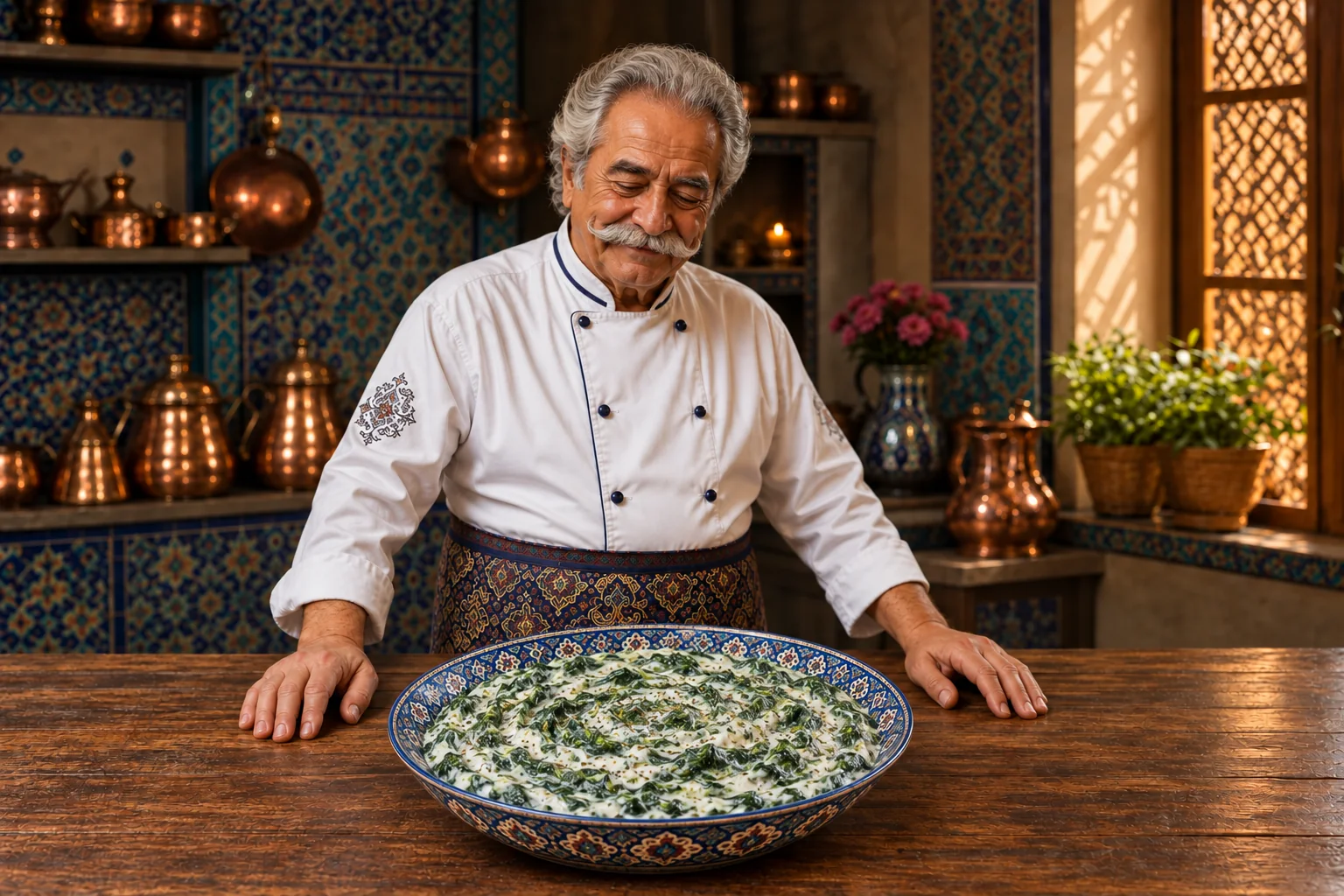
Borani names a family of dishes, not one fixed formula. This spinach-and-yogurt version belongs comfortably beside a rice meal or on a starter table. Some households add fried onion or walnuts; here, the finish stays simple.
The Persian Table12
09–10 of 136

The contents

34 chapters

  1. 01Reshteh PoloIran · a seasonal custom recorded near Kashan
  2. 02Khoresh KarafsIran · a shared household tradition
  3. 03Borani EsfenajIran · the wider borani family
  4. 04Persian HalvaIran · one branch of a wider sweet tradition
  5. 05Sharbat-e AlbalooIran · household sharbat traditions
  6. 06Adas PoloIran · a recorded Khorasan variation
  7. 07KotletIran · household cooking
  8. 08Salad ShiraziShiraz · Fars
  9. 09RanginakSouthern Iran · a Bushehr account
  10. 10Khakshir SharbatIran · everyday drink traditions
  11. 11Dolmeh Barg MoIran · a wider shared dolma tradition
  12. 12Joojeh KababIran · varied kebab traditions
  13. 13Khoresh BademjanIran · the khoresh tradition
  14. 14Shir BerenjIran · rice and household hospitality
  15. 15Persian TeaIran · Lahijan and the Caspian tea country
  16. 16Kabab KoobidehIran · Qajar accounts include Tabriz
  17. 17Loobia PoloIran · mixed-rice traditions
  18. 18Sabzi Polo ba MahiIran · Nowruz, with a Khorasan variation
  19. 19Dizi (Abgoosht)Iran · household and Qajar foodways
  20. 20Mirza GhasemiGilan · the Caspian coast
  21. 21TahdigIran · rice methods and Qajar accounts
  22. 22Ash ReshtehIran · household and communal foodways
  23. 23GheymehIran · the khoresh tradition
  24. 24Baghali Polo ba MahichehIran · a Caspian agricultural context
  25. 25Kuku SabziIran · regional kuku traditions
  26. 26Sholeh ZardIran · Qajar records and nazri traditions
  27. 27Faloodeh ShiraziShiraz · Fars
  28. 28DooghIran · neighboring pastoral traditions
  29. 29Sharbat-e SekanjabinIran · a wider vinegar-syrup tradition
  30. 30Ghormeh SabziIran · a documented custom near Kashan
  31. 31FesenjanGilan · later recorded across Iran
  32. 32Zereshk Polo ba MorghIran · barberry landscapes and Khorasan customs
  33. 33Tahchin MorghIran · rice cookery and Qajar documentation
  34. 34Kashk-e BademjanIran · pastoral foods and Qajar tables