Khoresh Karafs

The Persian Table

A book of food & history

Chapter 02 / 34Khoresh Karafs

Chef Naz · Food History Book

Chapter 02

Khoresh Karafs

A history kept in home kitchens

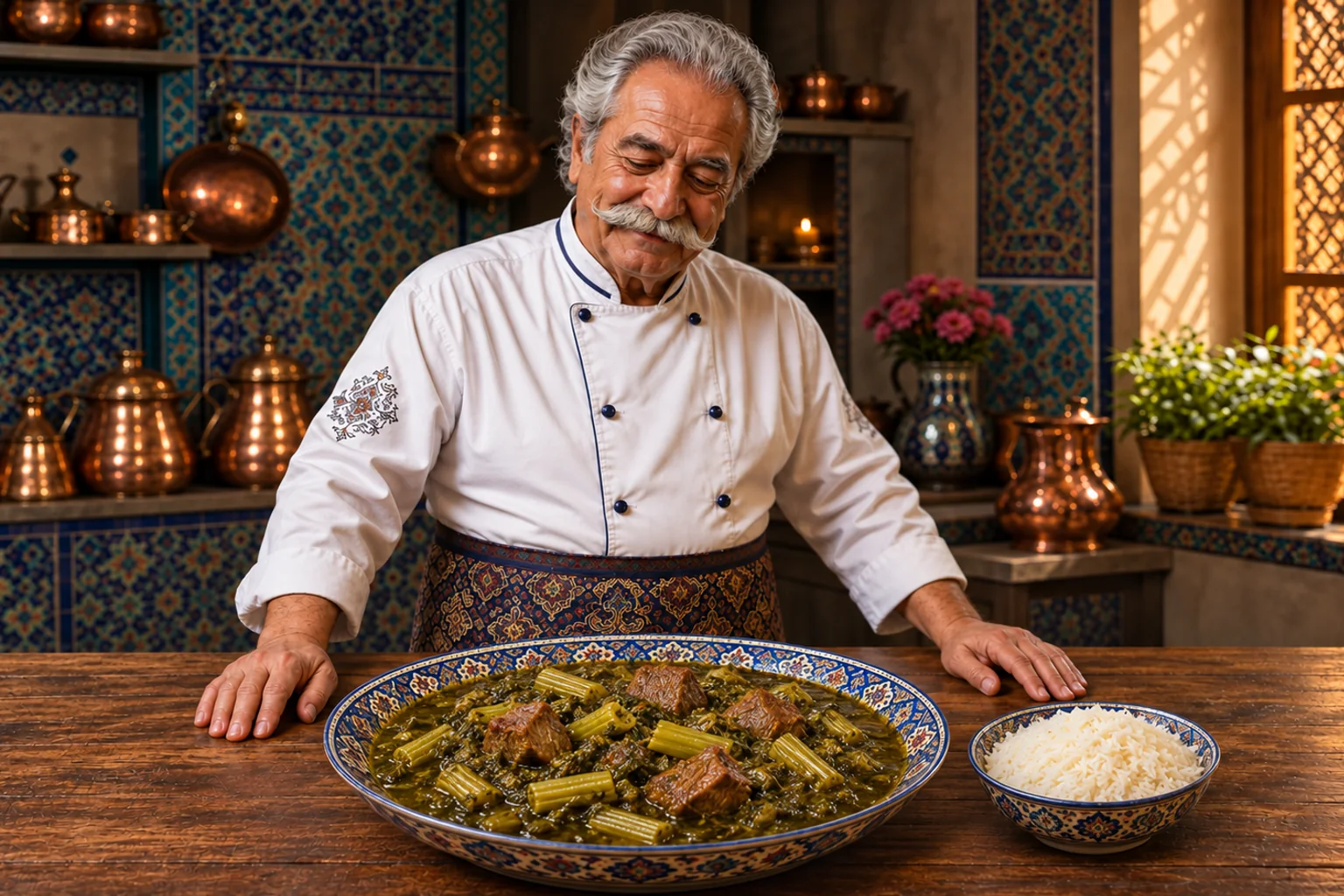
Chef Naz with Khoresh Karafs
Iran · a shared household tradition

The history, places and traditions behind the dish, with archival images and a closer look at the sources.

The Persian Table05

The historical record

At the family table

Khoresh karafs belongs to the everyday history of Iranian home cooking rather than a securely dated invention story. Its name identifies its central vegetable: karafs means celery. Contemporary Iranian cooks describe a slow-cooked stew of meat, celery, herbs, and a sour seasoning, served beside rice.

A hand-colored 1818 map by John Pinkerton. Historic borders and spellings reflect the map’s own period; the overlay is an editorial guide to culinary geography, not a territorial claim.

The marker refers to a shared Iranian home-cooking tradition. The sources establish neither a single city of origin nor a first date for this celery stew.

John Pinkerton · Wikimedia Commons · Public domain

John Pinkerton's hand-colored 1818 map of Persia and surrounding regions

View the archive record & image license ↗
The Persian Table06

Origins & development

The older tradition of khoresh

The broader tradition is older than any one modern recipe. Encyclopaedia Iranica's study of Qajar cuisine describes meat stews combining vegetables or herbs with sour flavorings and being served with rice. That provides historical context for this style of cooking, not proof that today's celery stew already had the same form. More recent first-person accounts, including Hasanzadenemati's memory of her mother's summer cooking, show how the dish is passed through home kitchens.

The Persian Table07

At the Persian table

Lemon or dried lime

The sour note varies from kitchen to kitchen. Shadi Hasanzadenemati's lamb version finishes with lemon, while Omid Roustaei's beef version uses dried limes. Those are meaningful household differences, not a contest for a single correct recipe. Here fresh lemon keeps the celery clear and recognizable, and plain rice is served separately.
The Persian Table08
05–06 of 136

The contents

34 chapters

  1. 01Reshteh PoloIran · a seasonal custom recorded near Kashan
  2. 02Khoresh KarafsIran · a shared household tradition
  3. 03Borani EsfenajIran · the wider borani family
  4. 04Persian HalvaIran · one branch of a wider sweet tradition
  5. 05Sharbat-e AlbalooIran · household sharbat traditions
  6. 06Adas PoloIran · a recorded Khorasan variation
  7. 07KotletIran · household cooking
  8. 08Salad ShiraziShiraz · Fars
  9. 09RanginakSouthern Iran · a Bushehr account
  10. 10Khakshir SharbatIran · everyday drink traditions
  11. 11Dolmeh Barg MoIran · a wider shared dolma tradition
  12. 12Joojeh KababIran · varied kebab traditions
  13. 13Khoresh BademjanIran · the khoresh tradition
  14. 14Shir BerenjIran · rice and household hospitality
  15. 15Persian TeaIran · Lahijan and the Caspian tea country
  16. 16Kabab KoobidehIran · Qajar accounts include Tabriz
  17. 17Loobia PoloIran · mixed-rice traditions
  18. 18Sabzi Polo ba MahiIran · Nowruz, with a Khorasan variation
  19. 19Dizi (Abgoosht)Iran · household and Qajar foodways
  20. 20Mirza GhasemiGilan · the Caspian coast
  21. 21TahdigIran · rice methods and Qajar accounts
  22. 22Ash ReshtehIran · household and communal foodways
  23. 23GheymehIran · the khoresh tradition
  24. 24Baghali Polo ba MahichehIran · a Caspian agricultural context
  25. 25Kuku SabziIran · regional kuku traditions
  26. 26Sholeh ZardIran · Qajar records and nazri traditions
  27. 27Faloodeh ShiraziShiraz · Fars
  28. 28DooghIran · neighboring pastoral traditions
  29. 29Sharbat-e SekanjabinIran · a wider vinegar-syrup tradition
  30. 30Ghormeh SabziIran · a documented custom near Kashan
  31. 31FesenjanGilan · later recorded across Iran
  32. 32Zereshk Polo ba MorghIran · barberry landscapes and Khorasan customs
  33. 33Tahchin MorghIran · rice cookery and Qajar documentation
  34. 34Kashk-e BademjanIran · pastoral foods and Qajar tables